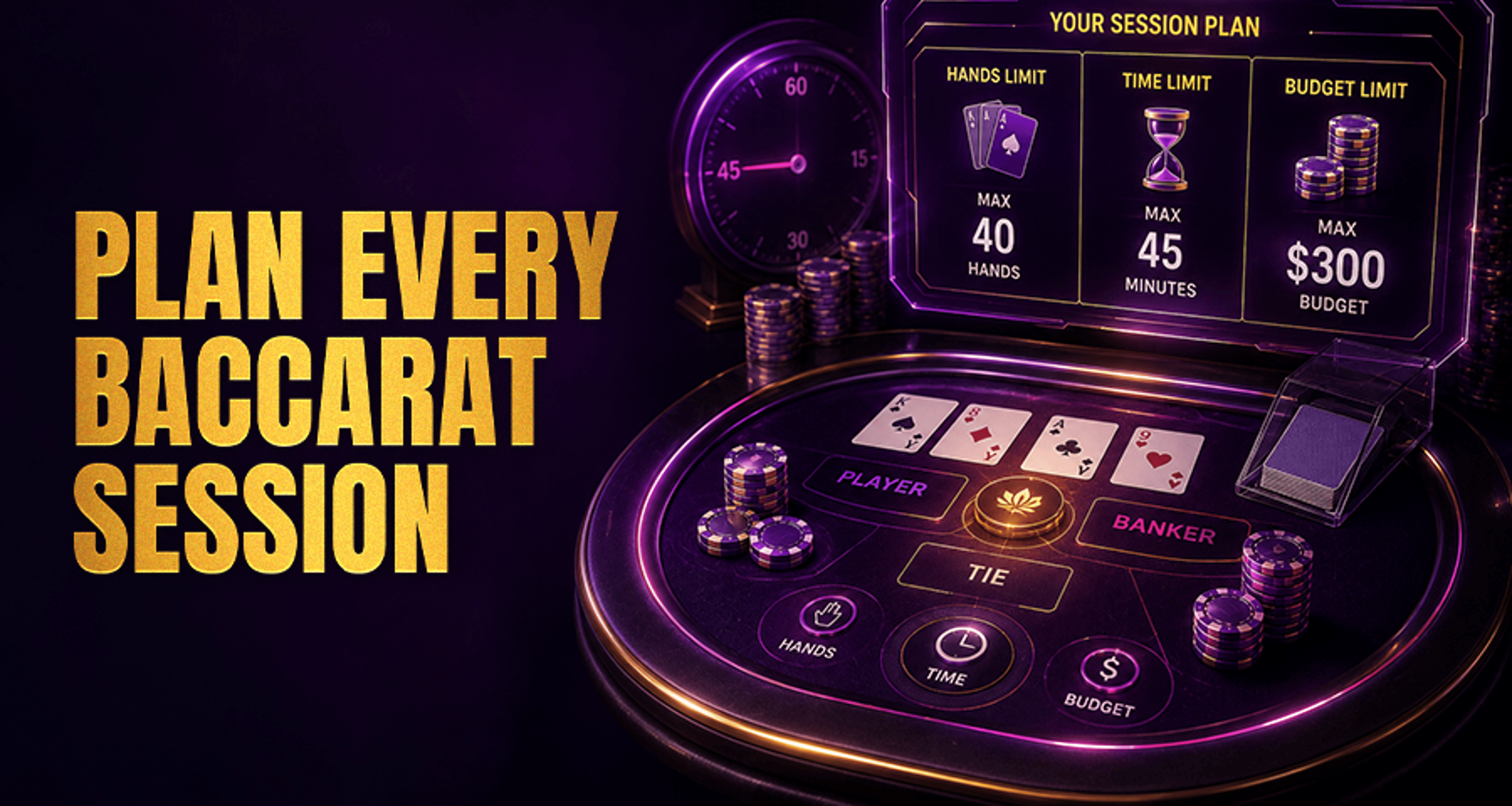
Baccarat Session Planning: Hands, Time, and Budget
Baccarat session planning means deciding how long you will play, how many hands you are willing to play, and how much money you are prepared to lose before the session starts.
Baccarat session planning means deciding how long you will play, how many hands you are willing to play, and how much money you are prepared to lose before the session starts. Those three decisions are connected: more time usually means more hands, and more hands usually mean more bankroll exposure.
That is why a useful baccarat plan is not about predicting outcomes. It is about setting boundaries so your session stays controlled, readable, and sustainable.
In practical terms, a baccarat session plan should answer three questions:
How much total time am I giving this session?
About how many hands am I comfortable playing?
What is my maximum session loss if things go badly?
Once those limits are set, it becomes easier to choose a reasonable bet size and to know when the session is over.
What baccarat session planning actually means
A baccarat session plan is a simple framework for managing pace and spending. Instead of sitting down and reacting hand by hand, you decide your structure in advance.
A complete plan usually includes:
a time cap, such as 20 minutes, 45 minutes, or 90 minutes
a hand cap, such as 25, 50, or 100 hands
a budget cap, meaning the maximum amount you are willing to lose in that session
a base betting unit, set conservatively relative to the total session budget
This matters because baccarat can feel fast, especially when you are playing continuously. Even though the game itself is simple, session pace can build quickly. If you do not set limits in advance, it is easy to play longer, place more bets, and expose more of your bankroll than intended.
Session planning does not change the randomness of baccarat outcomes. It does not lower the house edge or create a winning system. What it does is give you a way to control volume, time, and risk.
If you are still deciding how baccarat fits your preferences compared with similar table games, it can help to read guides like Roulette Vs Baccarat or Blackjack Vs Baccarat before setting your session style.
How many hands fit into a baccarat session
There is no single fixed number of baccarat hands per hour. Hand speed changes based on:
whether you are playing live dealer, in-person, or another table format
how quickly the table resolves each round
whether you pause between bets
how much time you spend watching trends, roadmaps, or side information
your own decision pace and attention level
Because of that, it is better to think in ranges rather than exact promises.
Here is a practical planning model:
Short session: around 20 to 40 hands
Medium session: around 40 to 80 hands
Long session: around 80 to 150+ hands
Those ranges are intentionally flexible. A faster table may move through the same number of hands much more quickly than a slower one.
Example time estimates by session type
These are variable estimates, not fixed rules:
Short session: roughly 15 to 30 minutes
Medium session: roughly 30 to 60 minutes
Long session: roughly 60 to 120+ minutes
A short session at a fast table may finish surprisingly quickly. A longer session with slower pacing, breaks, or more hesitation between bets may take much more time than expected.
That is why it is smart to plan around both time and hand count together rather than using only one measure.
How session time changes your bankroll exposure
The longer you play, the more betting decisions you make. The more hands you play, the more chances there are for normal short-term swings to affect your session budget.
This is the core idea behind baccarat session planning: time creates hand volume, and hand volume creates bankroll exposure.
For example:
A 20-minute session with modest pacing may keep your total action limited.
A 90-minute session with continuous betting may expose many more units, even if your base bet stays the same.
Two players with the same bankroll can face very different session risk if one plays 25 hands and the other plays 120.
This is also why players should avoid treating a session as open-ended. If there is no time limit, no hand limit, and no spending cap, the session can drift into a much larger bankroll commitment than planned.
If your goal is lower overall exposure, shortening the session or slowing the pace may matter as much as lowering the bet size.
How to set a baccarat budget before you start
A baccarat session budget should be built around loss tolerance, not profit expectations. In other words, start with the amount you can afford to lose for that session and stop there.
A simple budgeting structure looks like this:
Decide your maximum session loss.
Separate that amount from the rest of your gambling bankroll or entertainment budget.
Do not add funds mid-session to chase results.
End the session when the cap is reached.
Good session budgeting usually includes:
a hard loss limit for that session
a daily or weekly cap if you play more than once
a rule against increasing stakes just because the session started poorly
For example, if your session loss cap is $100, that number should represent the full amount you are prepared to lose before starting. It is not a target to recover, and it is not a reason to keep extending the session.
This kind of structure helps keep baccarat in the category of controlled play rather than reactive decision-making.
Choosing a conservative base bet for your session
A simple way to map bankroll to unit size is to start with your session budget and divide it into enough units to handle normal swings without forcing immediate escalation.
Conservative players often think in terms of making one betting unit a small fraction of the session budget. The point is not to optimize returns. The point is to make sure a short run of losses does not consume the entire session too quickly.
For example:
A $100 session budget might support a small base unit such as $2 to $5.
A $200 session budget might support a base unit such as $5 to $10.
A $500 session budget might support a base unit such as $10 to $20.
These are not formulas for success. They are examples of conservative scaling designed to slow down bankroll burn.
If your base bet feels too large for the number of hands or the session length you planned, it probably is. In that case, lower the unit or shorten the session.
Simple stop rules for hands, time, and loss limits
The easiest way to keep a baccarat session under control is to use stop rules that are decided before the first hand.
The three most useful stop rules are:
Time cap reached
Hand cap reached
Budget cap reached
Any one of those can end the session.
For example, your plan might say:
stop after 45 minutes
or stop after 60 hands
or stop after losing $120
That gives you multiple ways to stay within your limits. If the table is moving faster than expected, the hand cap may trigger first. If the session is dragging, the time cap may matter more. If the variance goes against you early, the loss limit protects the bankroll.
Some players also use a modest win-stop point, but it should never be treated as proof that the session is now predictable. Baccarat outcomes remain random, and stop rules are for discipline, not forecasting.
Sample baccarat session plans for different bankroll sizes
These examples are planning models only. They are meant to show how hands, time, and budget can be linked conservatively.
Small session plan
Session budget: $50 to $100
Base bet: $2 to $5
Hand target: 20 to 40 hands
Time cap: 15 to 30 minutes
Stop rule: end at time cap, hand cap, or full session loss limit
This kind of plan suits players who want tight control and limited exposure.
Mid-range session plan
Session budget: $100 to $250
Base bet: $5 to $10
Hand target: 40 to 80 hands
Time cap: 30 to 60 minutes
Stop rule: no reloads, no chasing, stop at preset loss cap
This is a more flexible structure, but it still depends on staying disciplined about pace.
Larger session plan
Session budget: $250 to $500+
Base bet: $10 to $20 or another conservative level relative to budget
Hand target: 60 to 120+ hands
Time cap: 45 to 120 minutes
Stop rule: end when any preset limit is reached
A larger budget does not make the session safer by itself. It simply allows more room for longer play if the unit size remains controlled.
If you are comparing session styles across games, educational pages such as Roulette Vs Baccarat and Blackjack Vs Baccarat can help you decide which pace and risk profile fit you better.
Common session-planning mistakes to avoid
A few common mistakes can undermine even a reasonable baccarat plan:
Treating hands per hour as fixed
Table speed varies. Planning with rigid assumptions can lead to much more action than expected.
Using only a money limit with no time or hand cap
A budget cap matters, but without time and hand limits, the session can still become longer and more intense than intended.
Choosing a base bet that is too large
If a few lost hands put the whole session under pressure, the unit size is probably too aggressive.
Chasing losses by raising stakes
Increasing bet size to recover quickly can escalate exposure fast. It is better to keep the original unit or end the session.
Confusing session control with prediction
Planning improves structure, not outcomes. Baccarat results remain random from hand to hand.
Final thoughts
Baccarat session planning is really about setting boundaries before you begin. When you decide your hand range, session length, and loss limit in advance, it becomes easier to keep the experience aligned with your risk tolerance.
A strong plan does not need to be complicated. It just needs to be clear:
how long you will play
how many hands you expect to play
how much you are willing to lose
what base bet fits that structure conservatively
which stop rule ends the session
That approach will not predict results or guarantee profit. What it can do is make baccarat more structured, more intentional, and easier to manage over time.
FAQ
How many baccarat hands can you play in one hour?
It depends on table type, platform speed, and your own betting pace. A faster setting may fit many more hands into an hour than a slower or more deliberate session, so planning with ranges is better than assuming one exact number.
How much money should you budget for a baccarat session?
Set a session budget based on the amount you are fully prepared to lose. That number should function as a hard loss cap, not as a target to recover once the session starts.
Should you plan baccarat by time or by number of hands?
The best approach is to use both. Time affects how long you stay engaged, while hand count affects how much betting volume you take on.
What is a good loss limit for a baccarat session?
A good loss limit is one that fits your personal bankroll and can be lost without affecting other obligations. It should be set before play begins and should not be increased during the session.
Does session planning improve baccarat results?
No. Session planning does not change the randomness of baccarat or remove the house edge. Its purpose is to improve control over time, hand volume, and spending.