Blackjack Insurance: Smart Move or Costly Trap?
In this guide, we break down blackjack insurance, its odds, and why most players get it wrong so you can make better decisions at the table.
What Is Blackjack Insurance?
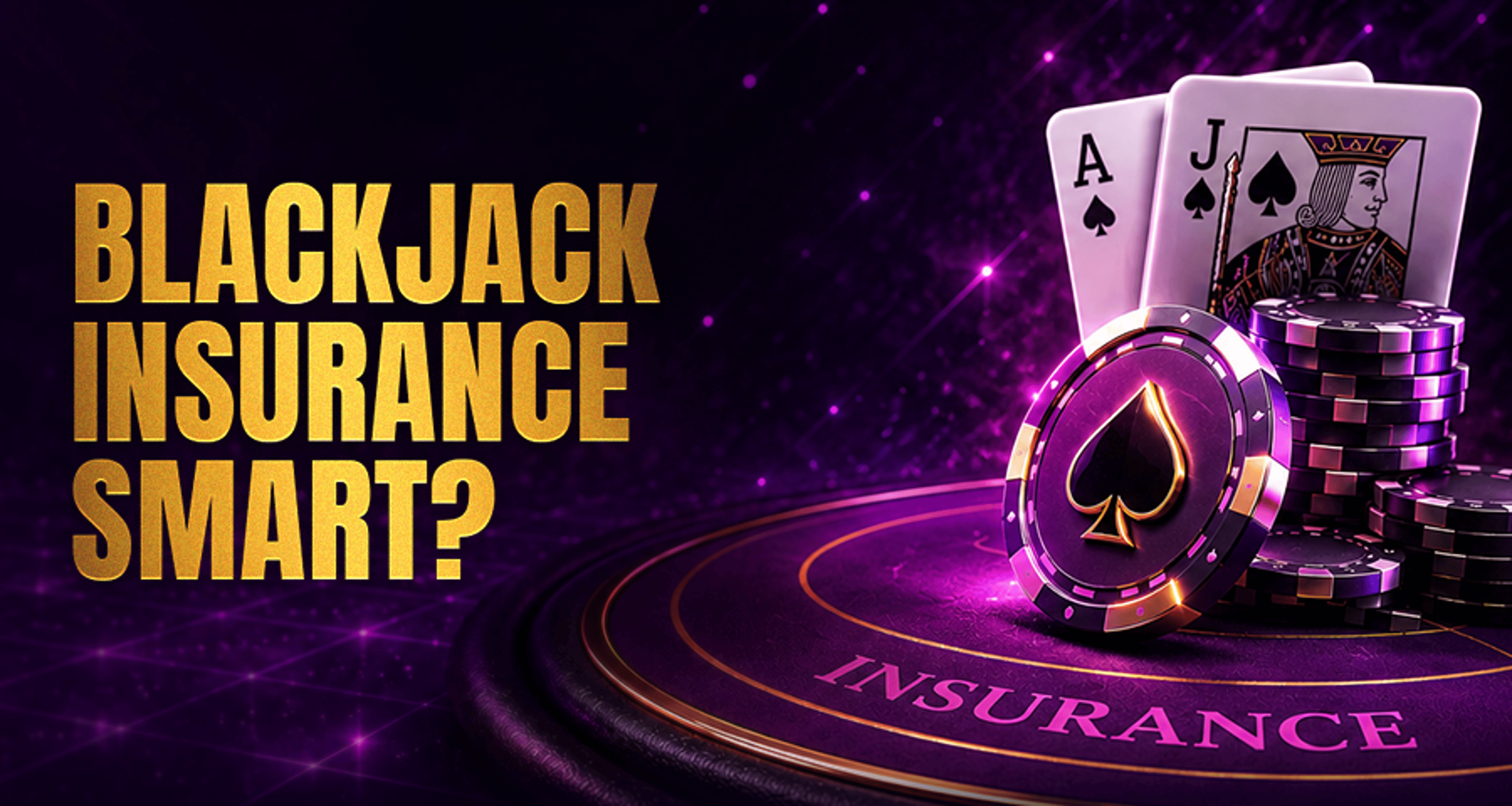
Blackjack insurance is often misunderstood as protection, but in reality, it is a separate side bet that increases risk rather than reducing it.
When Insurance Is Offered (Dealer Shows Ace)
Insurance becomes available only when the dealer’s upcard is an Ace. At that moment, players are offered the option to place an additional wager up to half of their original bet on whether the dealer has blackjack.
This situation feels dangerous because an Ace signals a strong dealer hand. Casinos use this moment of uncertainty to introduce insurance as a “safety net.”
How the Insurance Bet Works (Simple Example)
You bet $10 on your hand
Dealer shows an Ace
You place a $5 insurance bet
If dealer has blackjack → insurance pays 2:1 ($10)
If not → you lose the $5 insurance bet
Even if your main hand wins, the insurance bet is resolved separately. This is key: insurance is not protection—it’s an independent gamble.
Blackjack Insurance Odds Explained (Simple Math)
Blackjack insurance looks appealing on the surface, but the math tells a different story. Understanding the probabilities behind it is essential for making smarter decisions.
Probability of Dealer Blackjack
In a standard deck, there are 16 cards worth 10 points (10, J, Q, K). After an Ace is revealed, the chance the dealer has blackjack is roughly:
About 30% probability
However, for insurance to break even, the probability would need to be higher.
Why the 2:1 Payout Is Misleading
Insurance pays 2:1, which sounds fair. But mathematically, you would need a 33.3% probability to break even.
This gap—30% vs 33.3%—is where the casino gains its advantage.
Expected Value (EV) — Explained Simply
Expected Value explains the average outcome over time.
Think of insurance like buying travel insurance for a trip you rarely cancel:
You pay regularly
You rarely claim
The provider profits long-term
Insurance in blackjack works the same way—it produces a negative expected value, meaning consistent losses over time.
Why Blackjack Insurance Is a Losing Bet
House Edge Breakdown (~6%)
The House Edge on insurance bets is significantly higher than the main game.
Factor | Value |
Insurance payout | 2:1 |
Break-even odds | 33.3% |
Actual probability | ~30% |
House edge | ~6% |
This is much worse than standard blackjack, where the house edge can be under 1% with proper play.
Long-Term Loss vs Short-Term Wins
Insurance may win occasionally, creating the illusion of a good strategy. However:
Short-term wins = luck
Long-term outcome = consistent loss
Over hundreds of hands, the math always favors the casino.
Common Player Misconceptions
Many players believe:
“It protects my hand” → False
“It reduces risk” → False
“It’s safer than losing everything” → Misleading
In reality, it adds an extra bet with worse odds.
Even Money vs Insurance (Critical Insight)
What Is Even Money?
Even Money is offered when you have blackjack and the dealer shows an Ace.
Instead of risking a push, the casino offers a guaranteed 1:1 payout.
Why It’s Just Insurance in Disguise
Even money is effectively the same as taking insurance:
You trade a potential 3:2 payout
For a guaranteed but smaller return
Mathematically, it mirrors the same negative expected value.
Which Option Pays More Long-Term?
Option | Payout | Long-term Value |
Take insurance | 2:1 | Negative |
Take even money | 1:1 | Negative |
Decline both | 3:2 | Best choice |
The optimal decision is usually to decline both and rely on standard strategy.
When Should You Take Insurance?
The Only Exception: Card Counting
Card Counting can change the equation.
If a player knows that many 10-value cards remain in the deck, the probability of dealer blackjack increases. In rare cases, insurance can become profitable.
However, this requires:
Advanced skill
Real-time tracking
Casino tolerance (often limited)
Why Casual Players Should Always Avoid It
For the average player:
No deck tracking
No statistical edge
No long-term advantage
The best approach is simple: avoid insurance entirely and follow Basic Strategy.
Conclusion
Blackjack insurance may look like a smart safety net, but the math and strategy prove otherwise. It carries a high house edge, negative expected value, and relies on psychological pressure to succeed. For most players, the best move is clear: avoid insurance, stick to basic strategy, and focus on reducing the house edge.