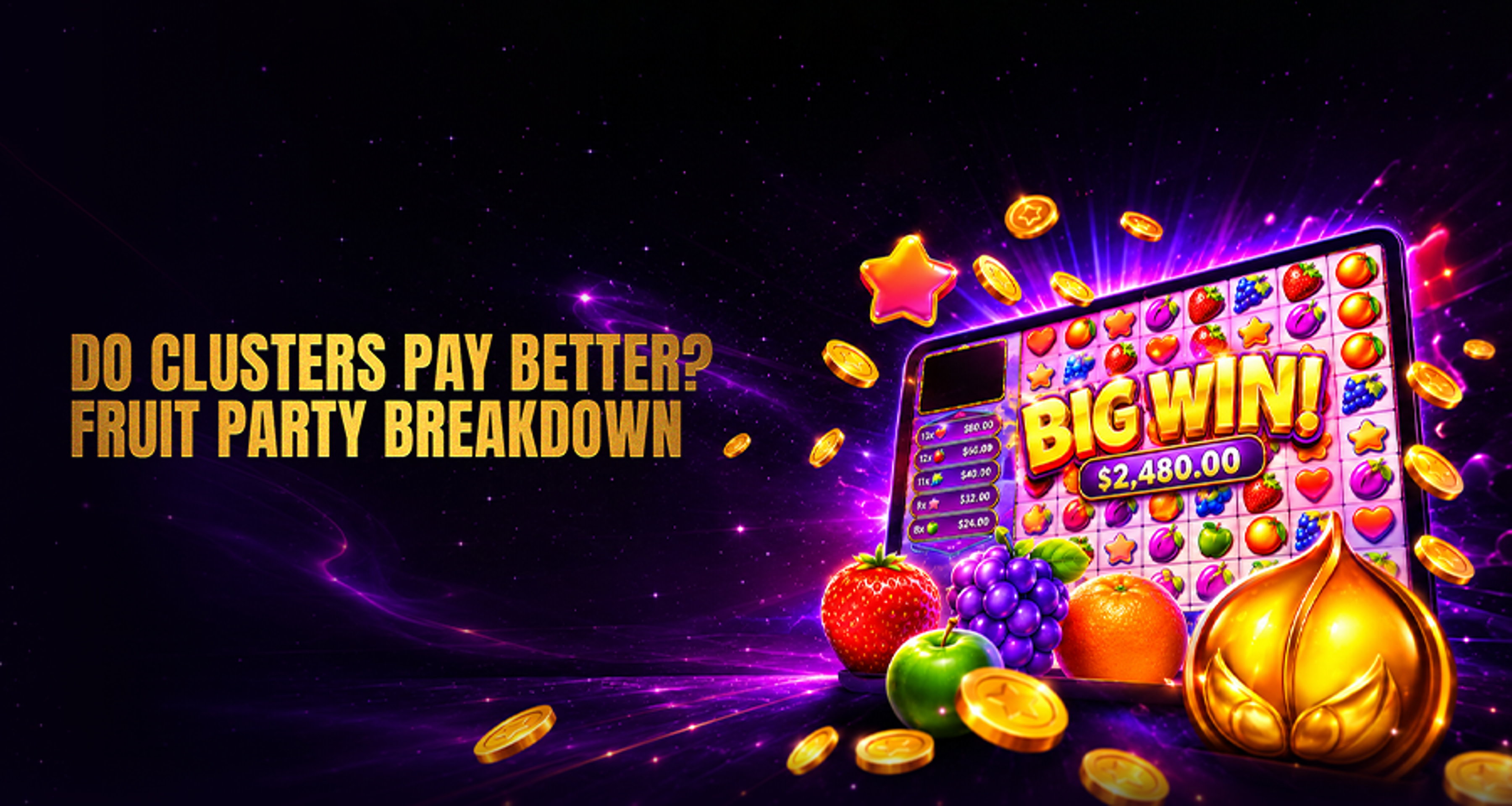
Fruit Party Series: Cluster Pays Done Right?
The Fruit Party series helped redefine cluster pays slots with simple gameplay, tumbling reels, and explosive multipliers. But does Fruit Party 2 actually improve the formula—or just increase the risk?
What Is the Fruit Party Series?
Overview of the franchise
The fruit party series is one of the most recognizable cluster-pay slot franchises, built around simplicity and high-impact multipliers.
Instead of relying on complicated paylines or layered bonus systems, it focuses on a clean grid and lets the mechanics do the heavy lifting. That’s exactly why it has remained relevant even as slot design trends evolve.
Developer and release timeline
Developed by Pragmatic Play, the series began with Fruit Party and later expanded with Fruit Party 2.
While the gap between releases wasn’t huge, the sequel reflects a clear response to player demand for bigger wins and more dynamic multiplier interactions—without overcomplicating the gameplay.
Core mechanics (cluster pays + tumbling reels + multipliers)
At its core, the fruit party series uses a 7x7 grid where wins are formed by clusters instead of paylines. When symbols connect, they disappear (tumble), allowing new ones to fall in and potentially create chain reactions.
On top of that, random multipliers can land within winning clusters, dramatically boosting payouts. This combination creates a gameplay loop that feels fast, reactive, and capable of sudden spikes.
=> One of the earliest slots to popularize cluster pays + random multipliers combo
Fruit Party (Original): Simple but Effective
7x7 grid and cluster pays system
The original Fruit Party strips things down to essentials. There are no paylines—just clusters of matching symbols across a 7x7 grid.
This makes the game extremely easy to understand, even for beginners. You don’t need to memorize patterns or strategies; you simply watch for clusters forming and expanding.
Random multipliers (up to 256x combined)
What makes the game exciting is the random multiplier system. Multipliers can appear on symbols within a cluster, and when multiple multipliers land together, they combine.
This creates moments where even small wins suddenly scale into significant payouts.
RTP (~96.5%), high volatility, max win (5,000x)
From a numbers perspective, the original sits in the standard RTP range but leans toward high volatility. That means fewer consistent wins, but occasional strong bursts when multipliers align.
=> Conclusion: Simple design, but strong multiplier mechanics drive big wins
Fruit Party 2: Evolution or Just More of the Same?
Improved multiplier system (wild multipliers stacking)
The sequel doesn’t reinvent the formula—it upgrades it. The biggest change is how multipliers work.
Instead of random standalone multipliers, Fruit Party 2 introduces wild multipliers that can stack more aggressively, leading to higher combined values during cascades.
Same 7x7 cluster grid with enhanced mechanics
The grid stays the same, which is intentional. Players already understand the system, so the focus shifts to making outcomes more explosive rather than changing how the game is played.
RTP (~96.53%), high volatility, max win (5,000x)
On paper, the stats look nearly identical. But in practice, the volatility feels higher because of how multiplier stacking behaves during bonus sequences.
=> Conclusion: A refined version with more explosive multiplier potential
Core Mechanics: Why Cluster Pays Works So Well
Cluster pays vs paylines
Unlike traditional slots, cluster pays don’t limit wins to fixed lines.
This increases flexibility and allows wins to happen anywhere on the grid, making gameplay feel more dynamic and less predictable.
Tumbling (cascading) reels explained
Every win triggers a tumble, removing winning symbols and replacing them with new ones. This creates chain reactions where a single spin can lead to multiple consecutive wins.
Multiplier stacking in clusters
The real magic happens when multipliers stack during cascades.
A single tumble sequence can escalate quickly, especially in Fruit Party 2, where multiplier interactions are more aggressive.
=> Key idea: Cluster pays allow chain reactions that amplify multipliers quickly
Key Differences: Fruit Party vs Fruit Party 2
Feature | Fruit Party | Fruit Party 2 |
Grid | 7x7 | 7x7 |
RTP | ~96.5% | ~96.53% |
Volatility | High | High (feels higher) |
Max Win | 5,000x | 5,000x |
Multipliers | Random on symbols | Wild multipliers + stacking |
Gameplay | Simpler | More explosive |
Does the Series Improve the Cluster Pays Formula?
More multiplier interaction
The sequel introduces deeper multiplier behavior, making each cascade more impactful. Instead of relying on luck alone, it builds intensity through stacking effects.
Better bonus round potential
Bonus rounds in Fruit Party 2 tend to feel more rewarding because of how multipliers interact over multiple tumbles.
The ceiling hasn’t changed, but the path to big wins feels more dramatic.
Increased volatility in sequel
With more explosive potential comes higher risk. Sessions can feel swingier, with longer dry spells followed by sudden spikes.
=> Insight: Fruit Party 2 enhances the intensity, not the structure
Which Version Pays Better?
Fruit Party – More balanced sessions
The original offers a smoother experience. Wins are smaller but more frequent, making it easier to manage your bankroll over longer sessions.
Fruit Party 2 – Bigger multiplier chains
The sequel leans heavily into volatility. When it pays, it can pay significantly more—but it may take longer to get there.
=> Conclusion: Fruit Party 2 offers more explosive payouts, but less consistency
Player Experience: Fun vs Profitability
Original – Simpler and more predictable
Ideal for players who prefer steady gameplay without extreme swings. It’s easier to follow and less mentally demanding.
Sequel – More exciting but volatile
Designed for players chasing bigger moments. The gameplay feels more intense, but also less forgiving.
=> Key takeaway: Better mechanics don’t always mean more consistent wins
Why the Fruit Party Series Stands Out
Clean and simple design
No unnecessary features—just core mechanics that work. This makes the series accessible to both beginners and experienced players.
Strong multiplier mechanics
Multipliers are the defining feature, turning ordinary spins into high-value outcomes when they align.
Easy-to-understand gameplay
Despite its potential for big wins, the game remains easy to pick up and play, which is a major reason for its lasting popularity.
Final Verdict: Cluster Pays Done Right?
Yes—for simplicity, engagement, and strong multiplier design. Even more so with Fruit Party 2, which pushes the formula further.
The fruit party series proves that simple mechanics + powerful multipliers can outperform more complex slot designs—especially when executed well.
FAQ Section
What is the Fruit Party series?
A cluster pays slot series known for random multipliers and tumbling reels.
Is Fruit Party 2 better than the original?
It offers more explosive wins but is more volatile.
What is the RTP of Fruit Party slots?
Around 96.5%, depending on the version.
Which Fruit Party pays more?
Fruit Party 2 has higher multiplier potential.
Are Fruit Party slots high volatility?
Yes, both versions are high volatility.
Why are cluster pays slots popular?
They allow chain reactions and bigger multiplier combinations.