Provably Fair Explained for Real Players: What It Proves and What It Does Not?
With provably fair explained real players learn how to verify game outcomes on-chain, exposing what cryptographic transparency actually guarantees—and what it doesn’t.
Provably fair is a way to verify that a supported game round was not changed after you placed your bet. In plain English, it helps you check that the result you received matches the inputs the game committed to before the round started.
That matters, but it has limits. Provably fair can help prove outcome integrity for certain games. It does not prove that a casino is trustworthy in every other way. It does not confirm fast withdrawals, fair bonus terms, strong player support, good licensing standards, or a safe overall experience.
For real players, that is the key idea: provably fair is a useful transparency tool, not a blanket trust certificate.
What provably fair means in plain English
A provably fair game gives players a way to check whether a round result was produced consistently, rather than altered after the fact. The system usually does this by combining a few known values and showing enough information after the round for the player to verify the outcome.
Most often, provably fair appears in crypto-focused games such as dice, crash, limbo, mines, and plinko. These formats are well suited to simple round-by-round verification.
If you are new to the topic, it helps to think of provably fair as a receipt system for game results. The casino commits to part of the result setup in advance, the round is played, and then the hidden value is revealed so you can check that the result lines up.
That is different from simply asking players to trust that the game is random. If you want a broader comparison, The Role of RNG and Provably Fair Systems Explained gives useful background on how those ideas fit together.
How provably fair works: hash, seeds, and nonce
You do not need developer-level knowledge to understand the basic chain. Most provably fair systems rely on four main pieces:
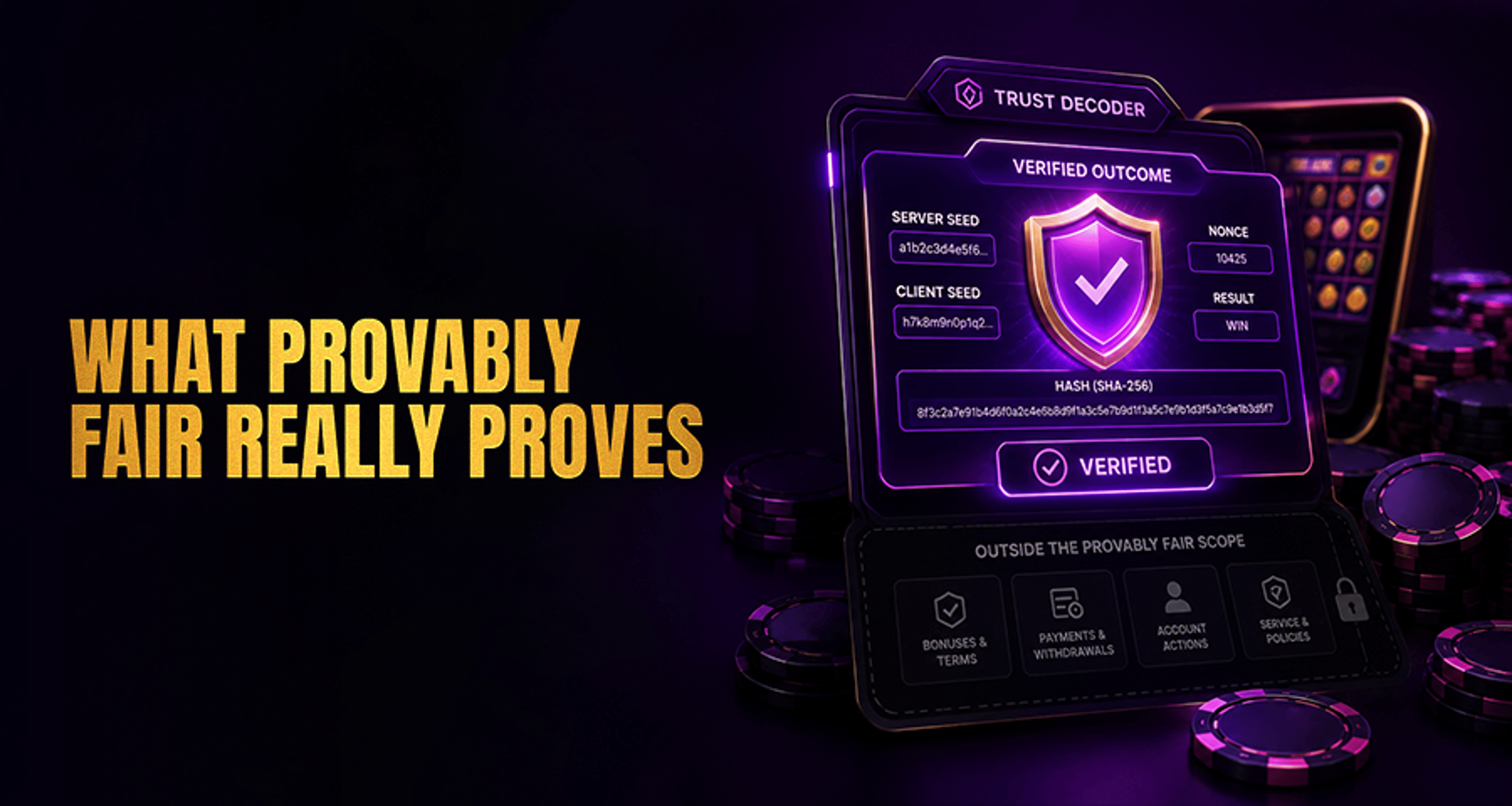
Server seed: a secret value created by the game before you play
Hash commitment: a scrambled fingerprint of that server seed, shown before the round so the casino cannot quietly swap it later
Client seed: a value chosen by the player, the system, or both, which adds another input to the result
Nonce: a counter that changes from round to round so repeated bets do not produce the same outcome
Here is the plain-language version of what happens:
Before the round begins, the casino creates a secret server seed.
It shows you the hash of that server seed, not the seed itself.
The round result is generated using the server seed, your client seed, and a nonce.
After the round or after a seed cycle ends, the casino reveals the original server seed.
You can compare the revealed seed with the earlier hash and recalculate the result.
The important part is the hash commitment. Because the hash is shown first, the casino is supposed to be locked into that server seed before the outcome is known. Later, when the original server seed is revealed, the hash should match the earlier commitment exactly.
What provably fair actually proves
Provably fair proves a narrow but useful thing: for supported games, it can show that a specific round outcome is consistent with the committed inputs and was not changed afterward.
That means it can help answer questions like:
Did the casino reveal the same server seed it committed to earlier?
Does the revealed seed produce the same result when combined with the client seed and nonce?
Was the round outcome generated according to the stated method?
If all of that checks out, you have evidence that the round result itself was handled consistently.
This is why many players like provably fair games. They offer a level of auditability that standard game interfaces often do not expose directly.
What provably fair does not prove about a casino
This is where many players get misled. Provably fair is useful, but it does not answer every trust question that matters before you deposit.
Provably fair does not prove:
that withdrawals will be processed quickly
that the casino is financially stable or solvent
that bonus terms are fair and reasonable
that customer support will help when something goes wrong
that the house edge is low or favorable to you
that the site has a strong reputation with real players
that every game on the casino uses the same transparent system
that the casino follows good responsible gambling standards
A casino can offer a provably fair dice game and still be frustrating in other ways. It may have slow cashouts, vague rules, poor support, or weak overall trust signals.
That is why reputation still matters. A broader guide like Casino Reputation Score: How to Spot Safe Trusted Casinos is useful because it looks beyond one technical feature.
Provably fair vs RNG: what is the difference?
Provably fair and RNG are related, but they are not the same thing.
RNG stands for random number generator. It refers to the mechanism used to create random or seemingly random outcomes in a game.
Provably fair adds a verification layer around game outcomes. It lets players inspect whether a supported result matches the pre-committed and revealed inputs.
A simple way to think about it:
RNG is about generating randomness
Provably fair is about giving players a way to audit the result flow
A game can rely on RNG without giving players meaningful post-round verification. That is common in many standard online casino games.
A provably fair game usually still uses a randomness process, but it also exposes enough information for the player to check the round independently.
Neither system alone covers every player risk. Even a transparent game result says nothing by itself about account restrictions, security issues, or payout handling. That is why trust-conscious players should also review broader safety topics like iGaming cybersecurity risks and how to stay safe.
How real players can verify a game result
In practice, verification should be simple enough for an ordinary player to follow.
A typical check looks like this:
Save the pre-round hash shown by the game before or during the betting session.
Note the client seed you used, if the game lets you set or view it.
Record the nonce for the round you want to inspect.
Wait for the server seed reveal when the game or seed cycle exposes it.
Compare the hash of the revealed server seed against the original hash commitment.
Use the site verifier or an independent checker to recalculate the outcome from the server seed, client seed, and nonce.
Confirm the result matches the round you actually received.
If the site says a game is provably fair but does not clearly show the seeds, nonce, hash, and verification path, that should make you cautious.
A good provably fair interface should let you:
see the current hash commitment before play
access past seeds and round history
understand how the result is calculated at a basic level
verify results without guessing where the inputs came from
Red flags when a casino says a game is provably fair
Some sites use the phrase as a marketing label without offering much real transparency. That is a problem.
Watch for red flags such as:
the game says “provably fair” but provides no visible seed data
there is no clear explanation of what the hash, client seed, or nonce do
past rounds cannot be reviewed or checked
the verification tool is missing, broken, or hard to find
only one small game section is provably fair, but the branding suggests the whole casino is
the site leans on the term while ignoring practical trust concerns like withdrawals, support, or rules
This matters across gambling categories. For example, games such as online bingo are usually evaluated differently, and players should not assume every casino product works like a provably fair crypto mini-game.
Which games commonly use provably fair systems
Provably fair is most common in game formats that are easy to verify round by round, including:
dice
crash
limbo
mines
plinko
sometimes simple card or wheel-style variants
These games tend to work well with seed-based result generation and transparent post-round checks.
By contrast, many traditional casino products do not present verification in the same direct player-facing way, even if they use standard RNG systems behind the scenes. That is why players should avoid assuming that “provably fair” applies equally across slots, live casino, table games, and every other category on a site.
A practical trust checklist beyond provably fair
Before depositing, use provably fair as one trust signal among several.
Here is a simple player-first checklist:
Check whether the verification is real: Can you view the hash, seeds, nonce, and result history?
Test the verifier: Does the game let you reproduce past outcomes clearly?
Read the rules: Are limits, edge cases, and game mechanics explained in plain language?
Review withdrawals: Look for consistent player feedback on cashout speed and disputes.
Assess support quality: Is help available when account or payment problems happen?
Look at reputation: Search for patterns, not just isolated complaints or praise.
Check security basics: Account protection and site hygiene still matter.
Separate one game from the whole casino: A transparent dice game does not automatically make the operator trustworthy everywhere else.
If you also want a broader perspective on how rankings and recommendations can shape player trust, Casino Affiliates Explained: Trust, Rankings, and Real Secrets adds useful context.
Final takeaway
Provably fair is best understood as a verification tool for supported game rounds. It can help you confirm that a result matches the committed inputs and was not changed after your bet.
That is valuable, but it is only one piece of the trust puzzle. It does not prove payout reliability, operator ethics, favorable odds, or a smooth player experience.
Real players should treat provably fair as a strong transparency signal when it is implemented well, then combine it with checks on withdrawals, support, rules, reputation, and overall site safety. From there, HunnyPlay’s trust-and-safety guides and curated provably fair game picks can help you build a more complete view before you play.
FAQ
Is provably fair the same as RNG?
No. RNG describes how randomness is generated, while provably fair adds a way for players to verify supported game outcomes after the round.
Can provably fair prove that a casino will pay me out?
No. It can help verify round integrity, but it does not prove withdrawal speed, solvency, or payout reliability.
Do all casino games support provably fair verification?
No. Provably fair is most common in certain crypto-style games such as dice, crash, limbo, mines, and plinko. It does not apply equally across every casino game category.
How do I check whether a provably fair result is legitimate?
You usually compare the revealed server seed to the earlier hash commitment, then use the server seed, client seed, and nonce to recalculate the result with the site verifier or an independent checker.
Can a provably fair game still have a house edge?
Yes. Provably fair does not remove the house edge. It helps verify how a result was produced, not whether the game is favorable to the player.
Why do some players trust provably fair games more than standard online casino games?
Because provably fair games can offer visible, round-level verification. That extra transparency can make players more confident in the integrity of supported outcomes, even though it does not solve every trust issue around a casino.