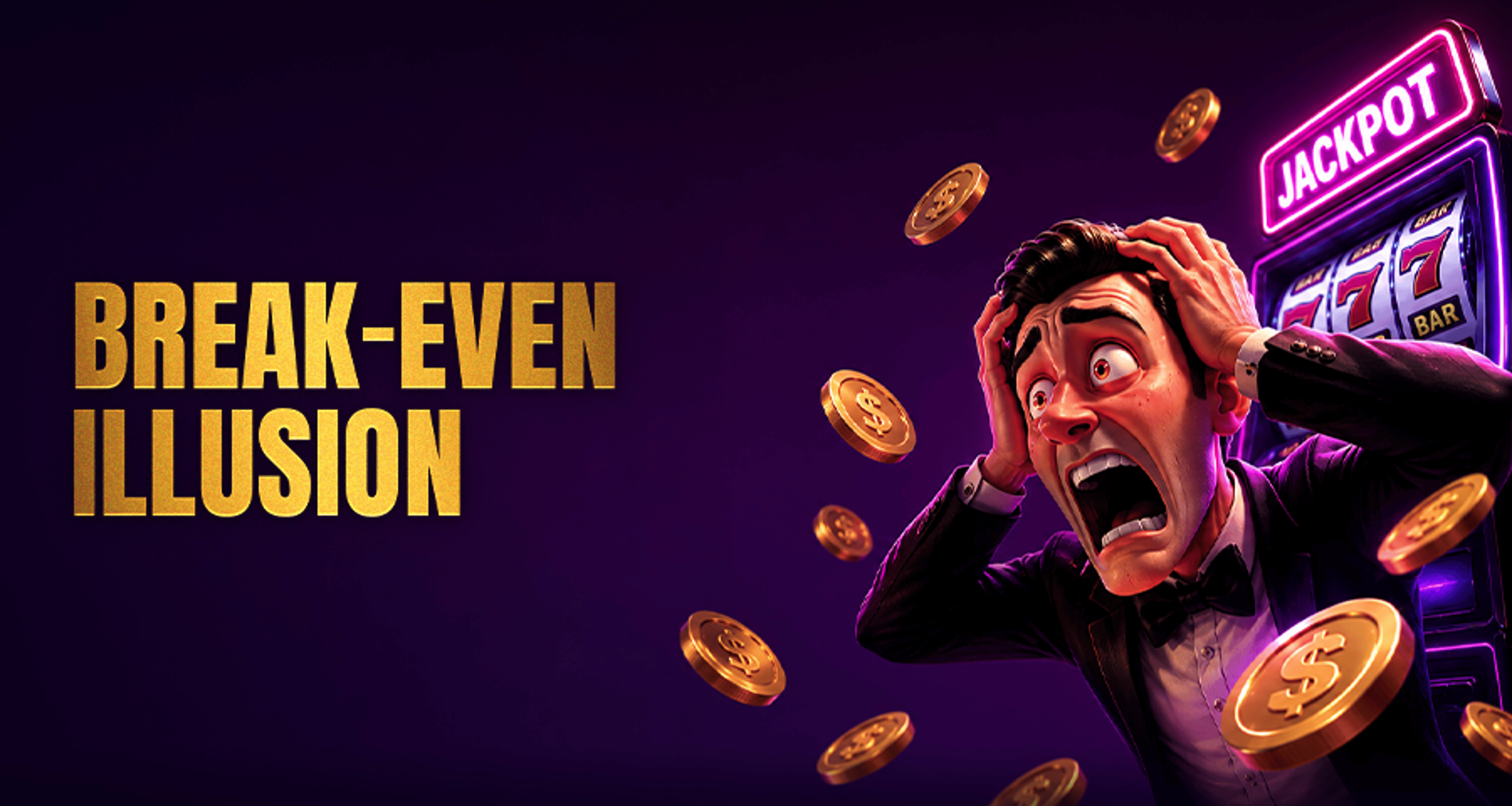
The “Break-Even Illusion” in Gambling Explained
The break-even illusion gambling mindset tricks players into believing one big win can erase every loss. Here’s why chasing losses feels logical emotionally—but dangerous mathematically.
1. What Is the Break-Even Illusion?
Definition of the concept
The break-even illusion gambling refers to the false belief that future wins can mentally or financially “cancel out” past losses, restoring a player to a neutral position.
Why players believe they can “reset to zero”
After losing, many players feel that recovering the exact amount lost will make the session feel acceptable again—even though the money is already gone.
Connection to gambling behavior
This mindset influences betting decisions, pushing players to continue playing longer than planned in hopes of recovery.
Insight: It’s the belief that one more win will fix everything
2. How the Break-Even Mindset Forms
After a losing streak
A few bad outcomes in a row can trigger frustration and the desire to “get it back quickly.”
Emotional decision-making
Instead of following strategy or limits, players react emotionally, often increasing bets or extending sessions.
Misinterpreting randomness
Players assume short-term outcomes reflect patterns, even though each result is independent.
3. Why the Brain Falls for It
Loss aversion (losses feel stronger than wins)
Psychologically, losing $100 feels worse than winning $100 feels good, creating urgency to recover losses.
Dopamine reward chasing
The brain remembers wins as emotional highs, encouraging continued play even after losses.
Cognitive bias in risk-taking
This is a form of illusion of control gambling, where players believe they can influence random outcomes through effort or persistence.
Key takeaway: The brain prioritizes recovering losses over rational play
4. The Connection to Chasing Losses
Increasing bets to recover losses
A common response is raising stakes after losses, hoping for a quicker recovery.
Emotional escalation
Frustration leads to riskier decisions, often outside normal strategy or limits.
Risk spiral effect
This cycle can quickly turn small losses into significantly larger ones.
Insight: Break-even thinking is the starting point of chasing losses
5. Why “Getting Back to Zero” Is Misleading
Money already spent cannot influence future outcomes
Past losses are fixed—they do not affect the probability of future spins or hands.
Each game round is independent
Whether it’s slots or table games, outcomes are determined by RNG or fixed odds.
House edge remains constant
No betting pattern or recovery attempt changes the built-in advantage of the casino.
6. Real Example of the Illusion in Action
Losing streak scenario
A player loses $100 in early sessions and feels the need to recover it immediately.
Increasing bets to recover
They double bets or extend playtime, hoping for a single big win to balance everything.
Final outcome vs expectation
Instead of breaking even, increased risk often leads to losing even more due to variance and continued exposure.
7. The Role of Gambling Speed
Faster games increase emotional pressure
Quick rounds reduce reflection time, making emotional decisions more likely.
Slots vs table games comparison
Fast-paced slots accelerate the break-even illusion gambling, while slower games like blackjack allow more controlled thinking.
Instant decision cycles
Continuous gameplay makes it harder to stop and reassess losses logically.
Insight: Faster gameplay amplifies break-even behavior
8. Why Casinos Don’t Need This Illusion
House edge ensures long-term advantage
Casinos profit over time regardless of short-term player outcomes.
Volume of play matters more than individual outcomes
More bets placed = more exposure to the house edge.
Variance balances short-term results
Even winning streaks are statistically balanced out over time.
9. How to Avoid the Break-Even Trap
Set loss limits before playing
Decide your maximum loss before starting and stick to it.
Accept losses as final
Treat each loss as part of the entertainment cost, not something to recover.
Avoid increasing bets emotionally
Bet sizing should follow strategy, not frustration.
Take breaks after losing streaks
Stepping away reduces impulsive decisions.
10. Smarter Gambling Mindset
Focus on entertainment value
Treat gambling as paid entertainment, not income recovery.
Treat each session independently
Avoid linking one session’s outcome to the next.
Prioritize bankroll control over recovery
Managing risk is more important than trying to “win it back.”
11. Comparison Table: Break-Even Thinking vs Rational Play
Factor | Break-Even Mindset | Rational Gambling Mindset |
Goal | Recover losses | Manage bankroll |
Emotion | Frustration-driven | Neutral / controlled |
Betting Style | Increasing stakes | Fixed strategy |
Risk Level | High | Controlled |
Outcome | Larger losses likely | Stable long-term play |
12. The Illusion That Costs the Most
The break-even illusion gambling mindset feels logical in the moment, but it is driven by casino behavior psychology rather than mathematical reality. It turns normal variance into emotional pressure and increases the risk of poor decisions.
You don’t “get back to zero”—you only decide what happens next.
FAQ Section
What is the break-even illusion in gambling?
It’s the belief that players can recover losses and return to zero through continued play.
Is it possible to break even in gambling?
Short-term yes, but long-term results are controlled by house edge.
Why do players chase losses?
Because of emotional bias and the desire to recover money quickly.
Does increasing bets help recover losses?
No, it usually increases risk and potential losses.
What causes the break-even mindset?
Loss aversion, emotional decision-making, and cognitive bias.
How can I avoid it?
Set limits, accept losses, and avoid emotional betting.