USDT Withdrawal Networks: TRC20, ERC20, and BEP20 Compared
If you are withdrawing USDT, the network you choose matters just as much as the amount you send. TRC20, ERC20, and BEP20 are not different versions of USDT in the everyday sense of value, but different blockchain
If you are withdrawing USDT, the network you choose matters just as much as the amount you send. TRC20, ERC20, and BEP20 are not different versions of USDT in the everyday sense of value, but different blockchain networks used to move the same asset.
That is why a USDT withdrawal can be cheap on one platform, more expensive on another, or even fail if the receiving side does not support the network you selected. The safest approach is simple: always match the withdrawal network to the receiving address network before you confirm.
This guide compares USDT withdrawal networks from a practical user perspective, so you can choose the right option for exchanges, personal wallets, and crypto payment platforms.
What USDT withdrawal networks actually mean
USDT exists on multiple blockchains. When you choose TRC20, ERC20, or BEP20 during a withdrawal, you are choosing which blockchain will carry that transfer.
TRC20 USDT runs on the Tron network
ERC20 USDT runs on the Ethereum network
BEP20 USDT runs on BNB Smart Chain
The important part is that the receiving wallet or platform must support that exact network. A wallet may support USDT, but only on certain chains. If you send USDT over the wrong network, the funds may not arrive correctly and recovery can be difficult or sometimes unavailable.
If you want a broader primer on the two most commonly compared formats, see TRC20 vs ERC20 key differences explained.
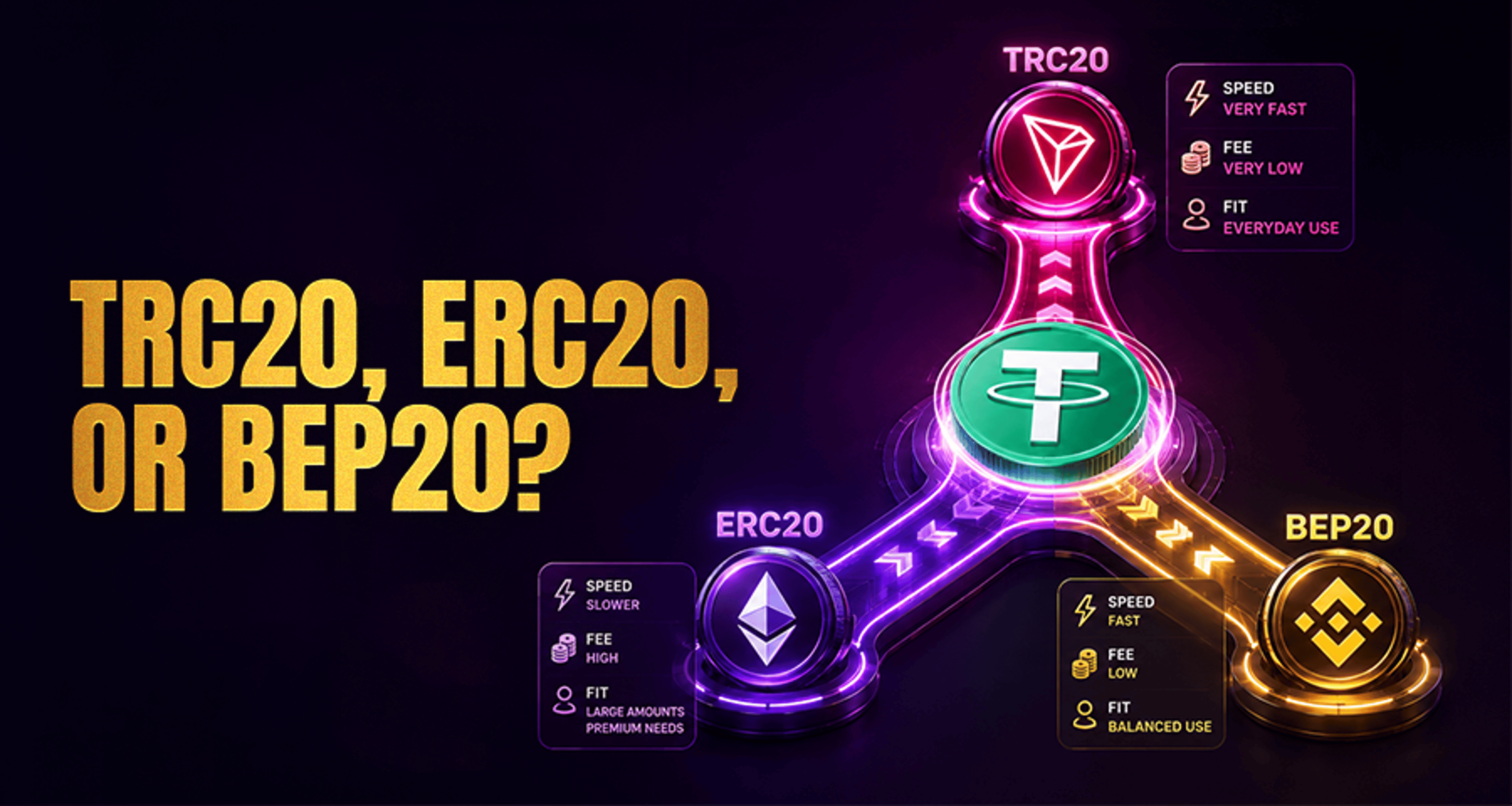
TRC20 vs ERC20 vs BEP20: key differences at a glance
Network | Blockchain | Typical withdrawal cost | Typical speed | Wallet and exchange support | Common use cases |
|---|---|---|---|---|---|
TRC20 | Tron | Often lower | Often fast | Widely supported, but not universal everywhere | Low-cost transfers between exchanges, wallets, and supported payment platforms |
ERC20 | Ethereum | Often higher | Can vary depending on network activity | Very broad support across exchanges, wallets, and services | Transfers where compatibility matters most |
BEP20 | BNB Smart Chain | Often lower | Often fast | Good support on many platforms, but more platform-dependent than ERC20 | Low-cost transfers where BNB Smart Chain is explicitly supported |
This is the core tradeoff:
TRC20 is often chosen for lower withdrawal costs
ERC20 is often chosen for broad compatibility
BEP20 is often chosen for low-cost transfers on platforms that support BNB Smart Chain well
No option is automatically best every time. The right network depends on where your USDT is going.
Which USDT network is cheapest for withdrawals
In many real-world cases, TRC20 and BEP20 are cheaper than ERC20 for USDT withdrawals. That is one reason many users prefer them for routine transfers.
However, “cheapest” should not be your only filter. A lower fee does not help if the destination only accepts ERC20 deposits. The better decision is to balance cost with confirmed compatibility.
If you are comparing payment options more broadly before moving funds to a gaming platform, casino payment methods compared by speed, safety, and fees can help frame the tradeoffs.
Which network is fastest and most convenient
For many users, TRC20 and BEP20 feel more convenient because transfers are often processed quickly and withdrawal costs are usually lower. That makes them practical for moving smaller or medium-sized amounts where efficiency matters.
ERC20 can still be the most convenient choice when the receiving exchange, wallet, or service clearly supports Ethereum-based USDT and may not reliably support other networks. In that case, compatibility matters more than saving on fees.
Convenience comes down to three checks:
Does the destination support the network?
Are the withdrawal fees reasonable for your transfer size?
Are current network conditions stable enough for the transfer you want to make?
How to choose the right network for your destination wallet or platform
The best network is usually the one that the receiving side explicitly supports with the least friction.
Withdrawing to another exchange
When sending USDT to another exchange, check the deposit page on the receiving exchange first. It will usually show the supported USDT networks.
Choose ERC20 if the exchange mainly supports Ethereum-based deposits or if you want the most familiar compatibility path
Choose TRC20 if the exchange supports Tron deposits and you want a lower-cost option
Choose BEP20 if the exchange supports BNB Smart Chain deposits and you prefer that route
Do not assume all exchanges support all three networks equally.
Withdrawing to a personal wallet
For self-custody, your wallet must support both USDT and the specific network you are using.
Use TRC20 if your wallet supports Tron-based USDT and you want lower transfer costs
Use ERC20 if your wallet is Ethereum-focused or you already manage assets on Ethereum
Use BEP20 if your wallet supports BNB Smart Chain and that is where you manage funds
Before withdrawing, confirm that the wallet address you copy belongs to the same network selected on the exchange.
Withdrawing to a crypto casino or payment platform
This is where users need to be extra careful. Some platforms support only one or two USDT networks for deposits, and instructions can vary.
Check the deposit page for supported USDT networks
Verify whether the platform labels the deposit as TRC20, ERC20, or BEP20
Do not rely on past assumptions from another platform
If you are comparing where crypto transfers fit into gaming payments, best online casino payment methods gives more context on how these options are commonly used.
Common USDT withdrawal mistakes to avoid
1. Sending to the wrong network
This is the biggest mistake. If the destination address expects ERC20 and you withdraw through TRC20, the transfer can end up unsupported or require a difficult recovery process.
2. Assuming the cheapest option is always best
A lower-fee network is only useful if the destination accepts it. Always confirm support first.
3. Ignoring temporary congestion
Network speed and cost can change based on platform conditions and blockchain activity. Even a normally convenient network may be slower during busy periods.
4. Skipping the deposit instructions
Before you confirm any withdrawal, read the deposit instructions on the receiving platform carefully. This matters for exchanges, self-custody wallets, and casino or payment platforms alike.
Best use cases for TRC20, ERC20, and BEP20
TRC20: best for lower-cost routine transfers
TRC20 is often a strong fit when:
You want to reduce withdrawal costs
The destination clearly supports Tron-based USDT
You are moving funds between platforms that already use TRC20 regularly
ERC20: best for broad compatibility
ERC20 is often the safer choice when:
The destination platform strongly supports Ethereum deposits
You want a widely recognized network option
You prefer compatibility over potentially lower fees
You can also compare the broader positioning of these formats in TRC20 vs ERC20.
BEP20: best for supported BNB Smart Chain routes
BEP20 is often useful when:
The destination explicitly supports BNB Smart Chain USDT
You want a lower-cost alternative to ERC20
You already use wallets or platforms built around BNB Smart Chain
Its main limitation is that support can be more platform-specific, so checking deposit instructions is especially important.
Risks to keep in mind before confirming a USDT withdrawal
Even when you choose the right network, there are still practical risks to watch for:
Wrong-network transfers: the most serious and most avoidable risk
Temporary congestion: may affect processing speed or costs
Platform-specific limitations: some exchanges and payment platforms support only selected networks
Instruction mismatch: a destination may accept USDT, but not on the network you planned to use
A few seconds of checking can prevent a much bigger problem later.
Final takeaway
When comparing USDT withdrawal networks, the smartest choice is usually not the one with the lowest fee alone. It is the one that matches your destination correctly, offers acceptable cost, and fits the platform you are using.
Choose TRC20 when supported and you want a lower-cost transfer
Choose ERC20 when compatibility is your top priority
Choose BEP20 when the destination clearly supports BNB Smart Chain and you want a low-cost alternative
Before transferring, check the supported deposit or withdrawal network on the destination platform one more time. Then, if you want more help comparing crypto-friendly gaming payment routes, continue with the relevant HunnyPlay payment and crypto guides.
FAQ
What happens if I send USDT on the wrong network?
The transfer may not reach the destination in a usable way. In some cases, recovery may be difficult, delayed, or unavailable. Always match the withdrawal network with the receiving network before sending.
Is TRC20 cheaper than ERC20 for USDT withdrawals?
Often, yes. TRC20 is commonly used because withdrawal costs are often lower than ERC20, but fees vary by platform and conditions.
Can I send ERC20 USDT to a TRC20 address?
No. You should not send ERC20 USDT to a TRC20 address. The withdrawal network and receiving network must match.
Which USDT network do most exchanges support?
Many exchanges support multiple USDT networks, but ERC20 is often one of the broadest supported options. That said, support differs by platform, so check the deposit page each time.
Is BEP20 USDT safe to use for withdrawals?
BEP20 can be a practical withdrawal option when the destination supports it. The key issue is not whether it is “better” in general, but whether the receiving wallet or platform is set up for BEP20 USDT.
How do I know which network my receiving wallet supports?
Open the deposit or receive section of the wallet or platform and check which USDT networks are listed. Use only the network that matches the receiving address instructions.