AVAX Casino Deposits: C-Chain vs Other Networks Explained
Using AVAX for a casino deposit can be simple, but one detail causes a lot of failed transfers: choosing the wrong network.
Using AVAX for a casino deposit can be simple, but one detail causes a lot of failed transfers: choosing the wrong network.
The problem is not usually the coin name. It is the route used to send it. A casino may support AVAX deposits only on one specific network, while your exchange or wallet may offer several ways to withdraw AVAX. If those two settings do not match, the deposit can be delayed, require manual recovery, or be unrecoverable.
This guide explains when Avalanche C-Chain matters, how it compares with other network options, and how to choose the correct route before you send anything.
What AVAX network choice means for casino deposits
When a casino says it accepts AVAX, that does not automatically mean every AVAX-related network is supported.
In practice, the important question is:
Which network does the casino want you to use for this AVAX deposit?
Many platforms show a deposit address together with a network label. That label is more important than the asset name alone. You may see AVAX available on:
Avalanche C-Chain
Another Avalanche network option in a wallet or exchange
A bridged or tokenized version of AVAX on a different blockchain
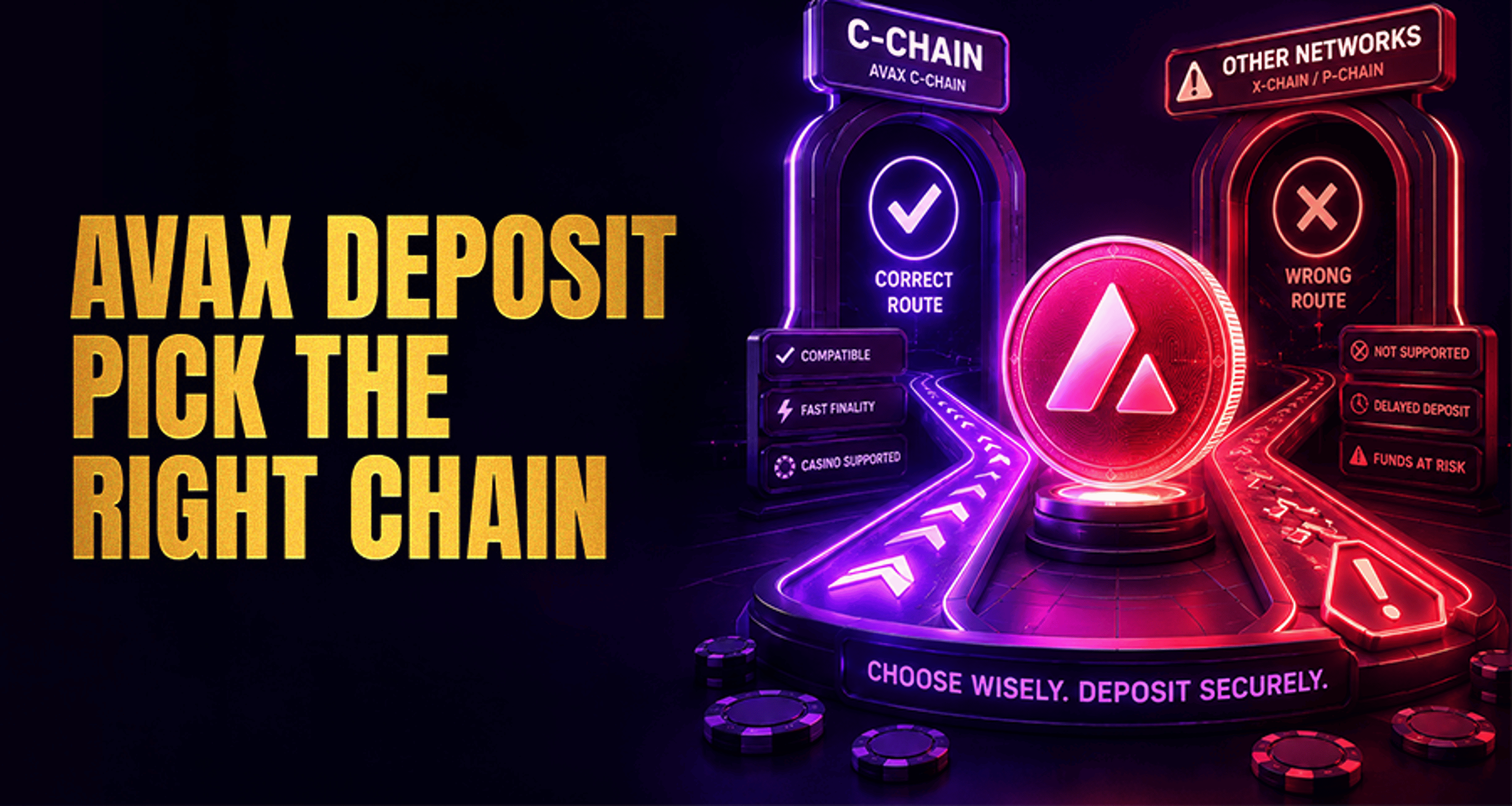
If the casino deposit page says Avalanche C-Chain, then your withdrawal must also be sent on Avalanche C-Chain. If the casino lists a different supported network, follow that exact instruction instead.
This is the same kind of issue users run into when comparing token standards and transfer rails such as TRC20 vs ERC20 differences: the asset name can look familiar, but the network behind it is what determines compatibility.
Avalanche C-Chain vs other networks: the difference that matters
Avalanche C-Chain is the EVM-compatible network in the Avalanche ecosystem. In plain English, that means it is the version most likely to work with platforms, wallets, and payment flows built around Ethereum-style address compatibility.
For casino deposits, that often makes C-Chain the most relevant AVAX network when the casino specifically lists it.
But C-Chain is not “correct” by default in every case. The correct network is always the one shown in the casino’s deposit instructions.
Here is the practical difference:
Network option | What it means for users | Compatibility risk | Speed and fee notes |
|---|---|---|---|
Avalanche C-Chain | Common EVM-compatible AVAX route | Lower risk if the casino explicitly supports C-Chain | Often competitive for speed and fees, but that does not help if the platform expects another route |
Other Avalanche network options | May appear in some wallets, exchanges, or advanced transfer setups | Higher risk if the casino does not list that exact network | Processing can still fail from a compatibility mismatch even if network performance is good |
Bridged or tokenized AVAX on another chain | AVAX represented on a different blockchain | Very high risk unless the casino clearly supports that specific chain and token version | Fees and speed depend on that external chain, not just Avalanche |
The key takeaway is simple: compatibility comes first, then speed and fees.
How to tell which AVAX network your casino accepts
Before sending AVAX, check the deposit page carefully. Look for:
The exact coin and network label
Any warning text about supported networks only
The address format shown on the deposit screen
Required confirmations or minimum deposit amounts
If the deposit page says something like “AVAX (Avalanche C-Chain),” do not assume that “AVAX” on another network is close enough.
If the page only says “AVAX” without a clear network label, pause and verify before sending. That may mean checking the platform’s help center or deposit instructions more closely before you proceed.
If you are comparing crypto rails more broadly, it also helps to understand how casino payment methods compare on speed, safety, and fees, because network support is often more important than headline transaction cost.
C-Chain vs alternative deposit routes: speed, fees, and compatibility
Users often focus first on which network is faster or cheaper. That is understandable, but it is the wrong first filter.
Compatibility
Compatibility is the deal-breaker. If your casino supports only one AVAX deposit network, that is the network you need to use. A cheaper or faster alternative is still the wrong choice if the receiving platform does not support it.
Speed expectations
C-Chain may offer good transaction speed in many cases, but real deposit timing depends on more than the blockchain alone. It can also depend on:
Exchange withdrawal processing time
Casino confirmation requirements
Internal review or account-crediting delays
So even if one network looks fast on paper, your actual deposit timing may vary.
Fee behavior
Network fees matter, but only after network support is confirmed. A low-fee transfer is not a good transfer if it arrives on an unsupported route.
If you want a broader baseline on transaction cost logic, see gas fees explained for casino users. It helps frame why low fees are useful only when the transfer path is actually compatible.
Common AVAX deposit mistakes and how to avoid them
Here are the mistakes that cause the most trouble.
1. Choosing AVAX by name without checking the network
A user sees AVAX in an exchange withdrawal menu and assumes any AVAX option will work. That is where many deposit problems begin.
How to avoid it: match the network label on the casino deposit page to the network label on the withdrawal screen.
2. Sending from an exchange that offers multiple AVAX withdrawal networks
Some exchanges present several network options for the same asset. One of them may be Avalanche C-Chain, while others may represent different routes or wrapped versions.
How to avoid it: do not choose based on the cheapest fee alone. Choose the one that exactly matches the casino’s supported deposit network.
3. Confusing Avalanche with bridged AVAX on another chain
A tokenized version of AVAX on another blockchain is not the same as native AVAX on the correct deposit network.
How to avoid it: if the casino does not explicitly list that other chain, do not use it.
4. Assuming recovery will be easy
Some users think support can always reverse or manually recover a misrouted deposit. That is not something you should rely on.
How to avoid it: assume that a wrong-network transfer may be difficult or impossible to recover, depending on platform support.
What to do before sending AVAX from an exchange or wallet
Use this checklist every time:
Open the casino deposit page and select AVAX
Confirm the exact supported network label
Check that your exchange or wallet offers that same withdrawal network
Compare the receiving address format carefully
Review any minimum deposit and confirmation requirements
Send a small test amount when the amount is meaningful enough to justify the extra step
Wait for the test deposit to credit before sending a larger amount
This same careful verification mindset also applies when reviewing best online casino payment methods, since the best method is often the one with the clearest support and lowest transfer-error risk for your situation.
When a small test deposit makes sense
A small test deposit is useful when:
Your exchange shows multiple AVAX networks
The casino’s network label is easy to misread
You are sending a larger-than-usual amount
You are using a new wallet or exchange for the first time
A test deposit does add one extra transaction, so it may not always be necessary for very small amounts. But when there is any doubt about network matching, it is often the safest move.
Real-world AVAX deposit scenarios
Scenario 1: Your exchange offers several AVAX withdrawal options
The casino deposit page says Avalanche C-Chain. Your exchange offers more than one AVAX route.
Best move: choose Avalanche C-Chain only if that exact label matches the casino instructions.
Scenario 2: The casino supports only one AVAX network
You were hoping to use a different route because the fee looked lower.
Best move: follow the casino’s listed network, not the cheapest alternative.
Scenario 3: You hold AVAX on another blockchain
You have a bridged or tokenized version of AVAX in a wallet on a separate chain.
Best move: do not send it directly unless the casino explicitly supports that exact token and chain combination.
FAQ
What is Avalanche C-Chain in casino deposits?
Avalanche C-Chain is the EVM-compatible Avalanche network and is often the most relevant option when a casino lists AVAX deposit support. But you should only use it when the casino specifically says to deposit AVAX on C-Chain.
Can I send AVAX on any network to a casino address?
No. You should send AVAX only on the exact network the casino supports for that deposit address.
What happens if I use the wrong AVAX network?
The deposit may be delayed, may require manual recovery, or may be unrecoverable, depending on the platform’s support and internal processes.
Is C-Chain faster or cheaper than other AVAX deposit options?
It may be competitive on speed and fees, but that is not the main decision point. The first priority is whether the casino supports it for deposits.
How do I know whether my exchange is sending native AVAX or a token on another network?
Check the withdrawal screen for the exact network label. If it does not match the casino deposit instructions, do not send until you confirm the correct route.
Should I do a test deposit before sending a larger AVAX amount?
Yes, a small test deposit can make sense when there are multiple network options, when the platform wording is unclear, or when the amount is large enough that a mistake would be costly.
Final takeaway
For AVAX casino deposits, Avalanche C-Chain is often the important option to understand because it is the EVM-compatible route many users will see. But it is only the right choice when it matches the casino’s deposit instructions exactly.
Before sending, check the supported network, match it on your exchange or wallet, confirm the address details, and use a small test deposit when needed. That extra minute of verification matters far more than chasing the lowest fee.