Deposit Cashback Wagering Rules: Wager vs No-Wager Cashback
Deposit cashback can look simple at first glance: deposit, play, and get back a percentage of losses or qualifying spend. The confusing part starts when the terms decide whether that cashback is treated like bonus money
Deposit cashback can look simple at first glance: deposit, play, and get back a percentage of losses or qualifying spend. The confusing part starts when the terms decide whether that cashback is treated like bonus money or real cash. That detail changes how easy it is to use, how quickly it can be withdrawn, and how much practical value the offer really has.
For players comparing casino promotions, understanding deposit cashback wagering rules matters more than the headline percentage alone. A smaller cashback offer with fewer restrictions can sometimes be more useful than a larger one loaded with rollover requirements, game exclusions, and expiry limits.
What deposit cashback means in casino bonus terms
Deposit cashback is a promotion linked to a deposit where the player receives some value back under specific conditions. In many cases, that cashback is triggered after losses on eligible games, though the exact structure can vary by operator.
What matters most is not just the percentage offered, but how the cashback is credited:
as bonus funds that come with wagering requirements
as cash or cash-equivalent balance with no wagering attached
as a mixed structure where the cashback itself is credited, but winnings from it still face limits or conditions
This is why cashback should be compared as part of the broader bonus structure, not in isolation. If you are weighing multiple offers, it also helps to understand how cashback fits within wider casino bonus types and which restrictions tend to reduce real value.
Wager cashback vs no-wager cashback: the core difference
The main difference is simple:
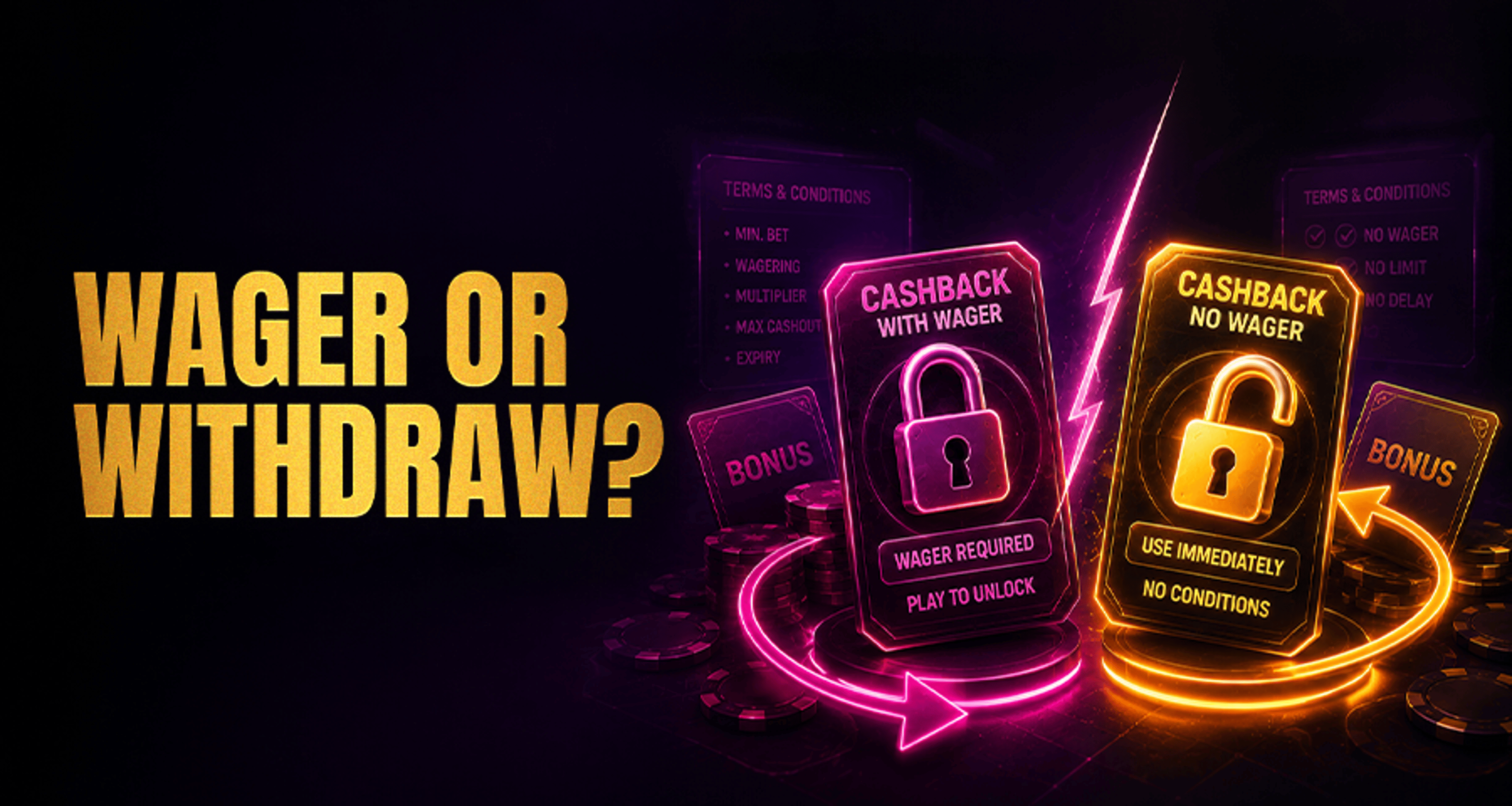
Wager cashback
Wager cashback means the returned amount cannot usually be withdrawn right away. Instead, it must be played through a stated number of times before it becomes withdrawable, if it becomes withdrawable at all.
For example, if cashback is credited as bonus funds, the terms may require the player to wager that amount before any withdrawal is allowed. In some cases, the rules may also limit how much can be cashed out after the wagering is completed.
No-wager cashback
No-wager cashback means the cashback is credited with no rollover attached to that cashback amount. In the best-case version, it lands as real cash balance and is usable or withdrawable under the standard account rules.
That said, "no wager" should still be read carefully. Some offers may remove wagering on the cashback itself but still apply restrictions elsewhere, such as:
a cap on how much can be withdrawn from winnings linked to the cashback
limits on eligible games
a short expiry window to use the funds
minimum deposit or claim conditions
So while no-wager cashback is usually easier to use, it is still important to read the fine print before assuming full flexibility.
How wagering rules change the real value of cashback
Two cashback offers with the same percentage can have very different practical value.
Imagine two promotions offering the same cashback rate on a qualifying deposit:
Offer A credits cashback as bonus funds with a rollover requirement, restricted game list, and short expiry period.
Offer B credits cashback as cash with no wagering, broader usability, and simpler withdrawal access.
Even though the advertised percentage is identical, Offer B may be far easier to use in real terms.
This is the key issue with deposit cashback wagering rules: playable value is shaped by friction. The more steps between receiving cashback and actually using or withdrawing it, the less valuable that offer may feel.
Important friction points include:
how many times the cashback must be wagered
whether only certain games count
whether different games contribute at different rates
whether there is a max cashout
how quickly the cashback expires
whether the funds are labeled bonus money or real cash
This is also why players often prefer lower-friction offers over bigger promotional numbers, a pattern that overlaps with what many notice when comparing high bonus vs low wagering offers.
Terms to check before you claim a cashback offer
Before claiming any deposit cashback, read the rules for these common points:
Rollover multiple
This shows whether the cashback amount must be wagered before withdrawal. If wagering applies, check whether it applies to:
the cashback amount itself
winnings generated from the cashback
other linked bonus funds rather than the cashback directly
Those differences can materially change the offer.
Max cashout
Some cashback promotions allow play but cap how much can ultimately be withdrawn. This can reduce the upside even if the wagering requirement looks manageable.
Eligible games
Cashback may only apply to selected games or categories. If your usual games are excluded, the offer may be less useful than it appears.
Contribution rates
Not all eligible games contribute equally toward wagering. Some may count fully, while others count only partially. That can slow progress toward clearing bonus-linked cashback.
Expiry window
A short deadline can make cashback hard to use, especially when wagering is attached. An offer is less attractive if the time limit is tight relative to the rollover burden.
Minimum deposit
Check the required deposit level and whether the cashback applies automatically or only after certain conditions are met.
Bonus money or real cash
This is one of the most important distinctions. If cashback is bonus money, restrictions are usually higher. If it is credited as real cash, the offer is often more flexible.
For readers comparing broader promotions, this sits at the heart of deciding which online casino bonuses are worth it: the terms usually matter more than the headline marketing.
When wager cashback may still fit your play style
Wager cashback is not automatically a bad offer. It may still be reasonable when:
the wagering requirement is relatively modest compared with the cashback amount
the eligible games match what you already play
the expiry period is long enough to use the funds naturally
the terms are clearly written and easy to follow
the cashback is part of a broader package you already intended to use
For some players, structured bonus value can still be acceptable if the restrictions are transparent and the offer suits their normal habits. The issue is not that wager cashback exists, but that it should be judged on usability rather than percentage alone.
Why no-wager cashback is usually easier to use
No-wager cashback is usually the simpler option because it reduces the gap between receiving value and being able to access it.
Its main advantages are:
less withdrawal friction
fewer rollover calculations to track
easier comparison between offers
more immediate usable value
That does not always mean it is automatically the better deal in every situation. A lower-friction offer can still be weakened by a strict max cashout, narrow game eligibility, or a very short validity period. But in general, no-wager cashback is easier for most bonus shoppers to understand and evaluate.
If you often find yourself stuck in complicated bonus conditions, it may be worth learning when to cancel a casino bonus rather than forcing value out of unclear terms.
Red flags that make cashback offers less attractive
Some cashback promotions lose appeal once the conditions are examined closely. Watch for these red flags:
vague wording about whether cashback is cash or bonus funds
unclear rules on whether winnings from cashback can be withdrawn
high rollover paired with a short expiry window
very limited eligible games
reduced contribution rates on common game types
low max cashout relative to the effort needed to clear the offer
terms that emphasize the headline percentage but bury the important restrictions
These are the same kinds of mechanics that often separate genuinely useful offers from promotions that look better on the landing page than in practice.
Quick checklist: how to compare deposit cashback offers
Before choosing a cashback promotion, ask:
Is the cashback credited as real cash or bonus money?
Does the cashback itself have wagering requirements?
Do winnings from the cashback have separate restrictions?
Is there a max cashout?
Which games are eligible?
Do all eligible games contribute equally?
How long do I have before the cashback expires?
Is the required deposit reasonable for the value offered?
Are the terms clear enough that I can explain them in one sentence?
If the answers are hard to find or difficult to understand, that is already a useful signal.
Conclusion
Deposit cashback can be useful, but only when the terms make the value accessible. The real difference between wager cashback and no-wager cashback is not just technical wording. It is how much effort, restriction, and uncertainty stands between the player and the actual benefit.
In many cases, no-wager cashback is easier to use because it reduces withdrawal friction and makes the offer easier to assess. Still, the best approach is to compare cashback terms carefully, focus on practical usability, and prioritize clear conditions over bigger headline percentages.
FAQ
What does wagering mean on deposit cashback?
Wagering means the cashback amount, or sometimes the value connected to it, must be played through a required number of times before withdrawal is allowed.
Is no-wager cashback always better than wager cashback?
Not always, but it is usually easier to use. A no-wager offer can still have other limits, while a wager cashback offer may still be reasonable if the restrictions are clear and relatively manageable.
Can you withdraw deposit cashback immediately?
Sometimes, but only if the cashback is credited as real cash and does not carry wagering or related restrictions. The specific terms decide this.
Do cashback winnings still have restrictions even if the cashback says no wagering?
They can. Some offers remove wagering on the cashback itself but still apply conditions such as max cashout limits, eligible game rules, or expiry periods.
What terms matter most when comparing cashback casino bonuses?
The most important terms are whether the cashback is real cash or bonus funds, the rollover multiple, eligible games, contribution rates, expiry window, minimum deposit, and any max cashout.
Why does one cashback offer with a lower percentage sometimes have better real value?
Because a lower-percentage offer with fewer restrictions can be easier to use and access, making its practical value stronger than a higher-percentage offer with heavy wagering or tight limitations.