Provably Fair Scratch Cards: How Fairness and RNG Work?
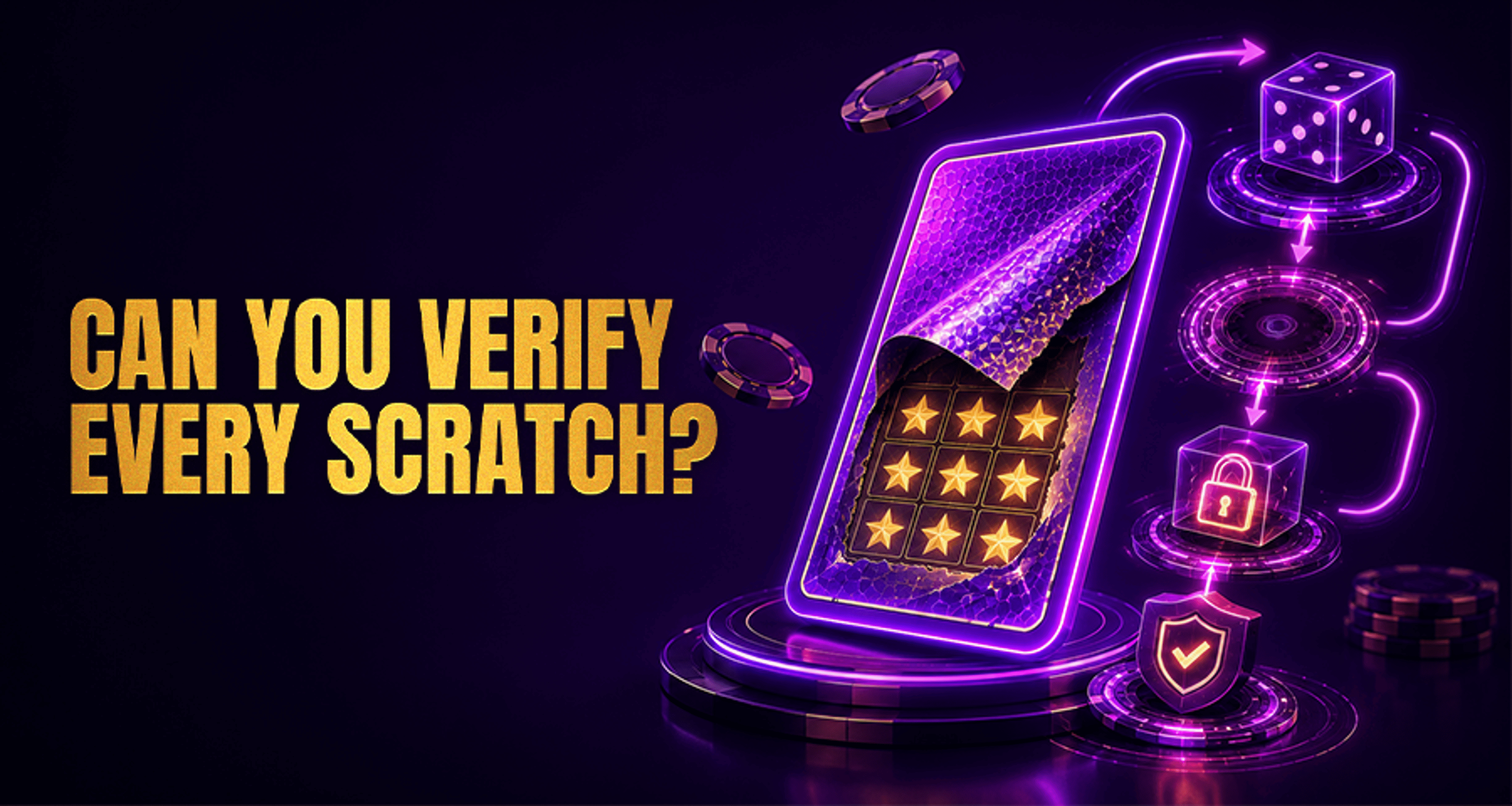
Provably fair scratch cards are scratch-card style games that let players check whether a result was generated fairly using cryptographic data, rather than asking them to trust the game blindly.
Provably fair scratch cards are scratch-card style games that let players check whether a result was generated fairly using cryptographic data, rather than asking them to trust the game blindly.
In plain English, the system creates a result from a combination of inputs, commits to key data before play, and then reveals enough information afterward for the player to verify that the outcome was not changed mid-game.
That sounds technical, but the core idea is simple: a provably fair system gives you a way to inspect how a scratch-card result was produced.
This matters because players often mix up several different concepts. Randomness is not the same as transparency. Fairness verification is not the same as payout rate. And a game can use RNG without giving you a practical way to confirm how one specific result was formed.
If you want a broader foundation first, Provably Fair Explained for Real Players helps frame what provably fair systems can and cannot prove.
What Are Provably Fair Scratch Cards?
Provably fair scratch cards are digital scratch-style games that use cryptographic methods so players can verify that a completed result came from pre-defined inputs rather than a post-play adjustment.
In a typical setup, the game uses:
a server seed created by the operator
a client seed chosen by the player or assigned to the session
a nonce, which is usually a counter that changes each round
a hash commitment that proves the server seed was fixed before the result was revealed
The final scratch-card outcome is then derived from those inputs through a deterministic process. That means if the same inputs are run through the same formula again, the same result should appear.
Not every scratch card works this way. Some games rely on standard RNG systems without player-verifiable proof. That is why it is important to look for actual disclosure and verification steps rather than assuming every scratch-card game is provably fair.
How RNG Works in Scratch Card Outcomes
RNG stands for random number generator. In digital scratch cards, RNG is typically the mechanism used to produce the underlying result before the symbols, prize fields, or reveal animation are shown to the player.
The important point is that the visible “scratch” is usually just the presentation layer. The meaningful event is the outcome generation that happens before or during the reveal flow.
In a provably fair scratch card, RNG still plays a role, but the system is structured so the outcome can be tied back to verifiable inputs. Instead of saying only “trust our randomizer,” the game says, in effect, “here is the committed seed, here are the round inputs, and here is how this specific result was produced.”
That creates a useful distinction:
RNG explains how outcomes are generated
Provably fair verification explains how players can check that a given outcome was not altered after the fact
Operators may also discuss broader fairness controls, audits, and platform integrity in other contexts. Those are related trust signals, but they are not identical to cryptographic result verification. For a wider view of operational trust systems, see How Platforms Ensure Fair Play at Scale.
How Server Seed, Client Seed, and Nonce Create a Verifiable Result
The exact math can vary by game, but the basic structure is often similar.
Server seed
The server seed is a secret value generated by the game operator. It is one of the key ingredients used to produce the result. Before the round is completed, the full server seed is usually hidden.
Client seed
The client seed is a value linked to the player side of the process. In some systems the player can choose it. In others, the system assigns it but still shows it for verification purposes.
Nonce
The nonce is commonly a number that increments with each game round. Its job is to prevent the same seed combination from producing the same output every time.
Combined result generation
A provably fair system typically combines the server seed, client seed, and nonce through a defined algorithm to produce a random-looking output. That output is then mapped to the scratch-card result.
For example, the process may look like this in principle:
The operator generates a secret server seed.
The game publishes a hash of that seed before play.
The player provides or receives a client seed.
The round uses a nonce value.
The system combines those inputs to generate the underlying result.
The scratch-card display reveals that result in a visual format.
Afterward, the full server seed can be revealed so the player can verify the round.
The key idea is not the animation or the card art. The key idea is that the outcome should be reproducible from disclosed inputs after the round is finished.
Why the Hashed Seed Commitment Matters Before You Play
The hash commitment is one of the most important parts of a provably fair system.
A hash is a one-way cryptographic fingerprint of the server seed. Before the player completes the game flow, the operator can publish the hash without revealing the seed itself. Later, when the full server seed is disclosed, the player can hash it independently and confirm that it matches the earlier commitment.
Why does that matter?
Because without a pre-commitment step, the operator could theoretically wait until after the result was known and then present a convenient seed. The commitment is what helps show the server seed was fixed in advance.
In plain terms:
Before play: you see the hashed version
After play: you see the original server seed
Verification: you confirm the revealed seed matches the earlier hash
That does not prove everything about the game, but it does help prove that the operator did not simply swap in a new server seed after seeing the result they wanted.
How to Verify a Provably Fair Scratch Card Step by Step
A practical verification flow usually looks like this:
Record the pre-game hash commitment. Before playing, note the hashed server seed if the game displays it.
Record the player-side inputs. Keep the client seed and note the nonce or round number if those are shown.
Play the round. Complete the scratch-card game as normal.
Get the revealed server seed afterward. A transparent system should eventually reveal the original server seed tied to that commitment.
Check the hash match. Hash the revealed server seed using the stated method and confirm it matches the pre-game hash.
Recreate the result. Use the server seed, client seed, and nonce in the disclosed formula or verifier.
Compare the recreated output to the shown outcome. The reproduced output should map to the same scratch-card result you received.
Simple example
Imagine a scratch-card game shows you:
a hashed server seed before play
your client seed for the round
nonce 12
You finish the round and see the final result. Afterward, the game reveals the original server seed.
To verify the round, you would:
hash the revealed server seed and compare it with the earlier commitment
combine the revealed server seed, your client seed, and nonce 12 using the game’s stated method
check whether that recreated output maps to the same scratch-card result shown on your screen
If both checks match, that supports the claim that the round outcome was generated from the committed inputs and not changed after the fact.
If you are comparing different game formats, articles about original casino games and provably fair picks can also help you see how verification ideas appear across game types.
Provably Fair vs RNG: What Is the Difference?
This is where many players get confused.
RNG
RNG refers to the mechanism that generates unpredictable outcomes. A game can be RNG-based without giving the player any direct way to verify a specific result.
Provably fair
Provably fair refers to a verification framework. It gives the player data and a method to check that a result came from committed inputs and was not altered after commitment.
They overlap, but they are not identical
A provably fair scratch card still relies on randomness in some form. But “uses RNG” and “is provably fair” are not interchangeable claims.
Likewise, regulated RNG testing and cryptographic provable-fair verification are not the same thing:
RNG auditing generally focuses on whether the system behaves randomly and within expected parameters over time
Provably fair verification focuses on whether an individual game result can be independently checked against committed cryptographic inputs
A game may have one, the other, or both. Players should avoid assuming that one label automatically includes the other.
What Provably Fair Can Prove — and What It Cannot
Provably fair can be very useful, but it has limits.
What it can help prove
the server seed was committed before reveal if the hash matches
the disclosed inputs reproduce the same round result
the operator did not alter that specific result after the commitment step, assuming the disclosed process is accurate
What it does not prove by itself
that the game has a high RTP
that wins happen frequently
that volatility suits your preferences
that the game is profitable to play
that every part of the wider platform is trustworthy
that the mapping from random output to prize structure is generous or favorable
This distinction matters a lot. A scratch card can be verifiable in how it produces results while still having a low hit rate or an unfavorable payout structure. Provably fair does not mean better odds.
In other words:
Randomness is about unpredictability
Fairness verification is about transparency of result generation
RTP is about theoretical long-run return
Win frequency is about how often prizes may appear
These ideas connect, but they are not substitutes for each other.
How to Check Whether a Scratch Card Fairness Claim Is Credible
If a game claims to be provably fair, look for specific evidence rather than marketing language.
Practical checklist for players
Is there a visible pre-game hash commitment? If not, the core proof step may be missing.
Are the server seed, client seed, and nonce explained clearly? If the terms appear without explanation, the system may not be meaningfully transparent.
Can you access the revealed server seed after play? Verification is hard or impossible without it.
Is there a disclosed method for recreating the outcome? Players should be able to follow the logic of result generation.
Can you verify results independently? A built-in checker may help, but ideally the method is clear enough to audit outside the game as well.
Does the game explain what provably fair does not prove? Credible disclosures usually acknowledge limits instead of overselling certainty.
Are fairness claims separated from security claims? Platform safety, account protection, and fairness verification are related but different topics. For broader safety context, see iGaming cybersecurity risks and how to stay safe.
Are the explanations readable in plain language? If the system cannot be explained clearly, many players will struggle to validate it properly.
A trustworthy claim is usually specific, testable, and modest. A weak claim is vague, absolute, or impossible for the player to check.
Conclusion
Provably fair scratch cards can offer a stronger form of transparency than ordinary “trust us” randomness claims because they let players inspect how a specific outcome was generated. The core pieces usually include RNG, a server seed, a client seed, a nonce, and a pre-play hash commitment that can be checked after the round.
But provably fair does not mean every scratch card is trustworthy, and it does not guarantee better odds, higher RTP, or frequent wins. What it does offer is a way to verify whether a result matches the committed inputs.
For players researching trust and safety, the best next step is simple: learn how to read fairness disclosures, check whether a scratch-card game provides real verification data, and confirm that its claims are specific enough to test rather than merely impressive-sounding.
FAQ
What does provably fair mean in scratch cards?
It means a scratch-card style game provides cryptographic proof steps that let players verify whether a result was generated from committed inputs and not changed after the fact.
Are provably fair scratch cards different from regular RNG games?
Yes. Both may use RNG, but provably fair scratch cards also provide a verification method tied to seeds, a nonce, and a pre-committed hash.
Can I verify a scratch card result myself?
In a genuinely transparent system, yes. You should be able to compare the revealed server seed with the earlier hash and recreate the result using the disclosed inputs and method.
Does provably fair mean better odds?
No. Provably fair does not guarantee better odds, higher RTP, or more frequent wins. It is about verifying result integrity, not improving payouts.
What is the difference between RTP and provably fair?
RTP refers to the theoretical long-run return of a game. Provably fair refers to a cryptographic method for checking whether individual results were generated as claimed.
What do server seed and client seed do in a provably fair game?
They are core inputs used to generate the result. The server seed comes from the operator, the client seed comes from the player side or session, and both are typically combined with a nonce to create a verifiable outcome.
Can a game be random without being provably fair?
Yes. A game can use RNG and still give players no practical way to verify an individual result. Randomness alone is not the same as provable fairness.