Does Grid Size Change Your Odds in Mines?
A mines grid size strategy change can affect your chances of finding safe tiles, but bigger boards do not automatically mean better value. Grid size, mine density, and payouts work together to shape risk.
If you are asking whether a Mines grid size strategy change affects your odds, the short answer is yes—but not in the way many players assume.
Changing the board size can improve or reduce your chance of hitting a safe tile, especially on the opening picks. But that does not automatically means a better long-run return. In Mines, board size, mine density, and payout calibration all work together.
So, does grid size change your odds in Mines? Yes for short-term survival odds. Not necessarily for long-run expected value.
What Grid Size Changes in Mines
In Mines, every board is a mix of safe tiles and hidden mines. When the grid changes, the total number of tiles changes too.
That affects your click-by-click probability because each pick depends on:
Total tiles on the board Number of mines in play Number of successful picks already made
If the mine count stays the same, a larger board usually gives you better early safety because the mines occupy a smaller share of the layout. But if the number of mines increases with the board size, that advantage can narrow or disappear.
That is why a change in Mines board size can alter the feel of the game without automatically creating a better setup overall.
A Simple Example: Same Mine Count, Different Board Size
A quick way to compare Mines board size odds is to look at first-click safety.
The basic formula is:
Safe tiles / Total tiles
For example, with the same 3 mines:
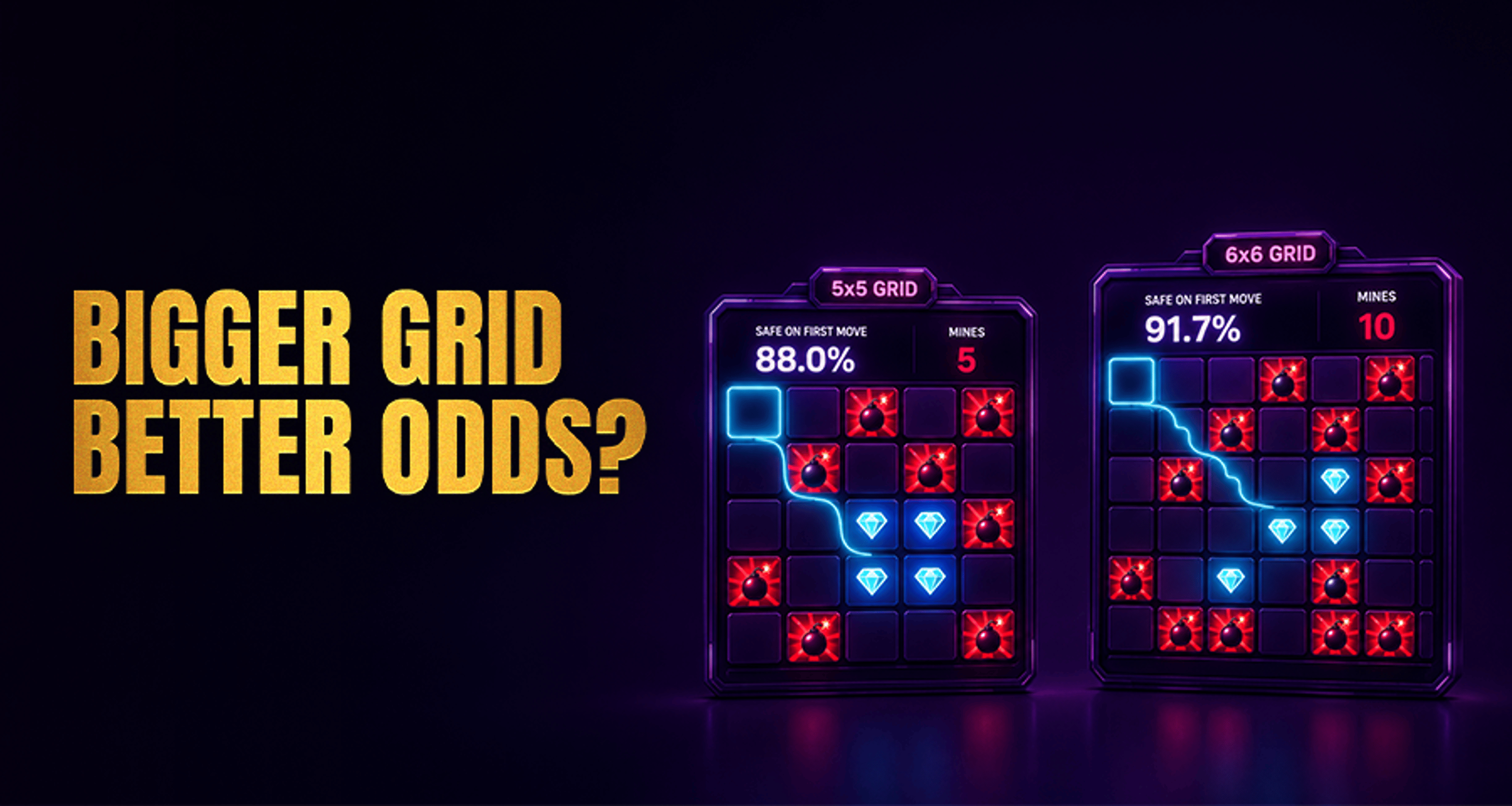
5x5 board: 22 safe tiles out of 25 = 88.0% first-pick safety
6x6 board: 33 safe tiles out of 36 = 91.7% first-pick safety
So in that exact comparison, the larger board is safer on the first click.
But that does not prove it is the better long-run option. A casino or game version can recalibrate the payout ladder so that safer early picks come with slower multiplier growth. That means RTP or expected value may still remain similar even if the opening click feels easier.
Comparison Table: How Grid Size Can Affect Early Odds
Board Size | Mine Count | Safe Tiles | First-Pick Safe Odds | What It Suggests |
|---|---|---|---|---|
5x5 (25) | 3 | 22 | 88.0% | Solid early safety |
6x6 (36) | 3 | 33 | 91.7% | Safer first click if mines stay fixed |
5x5 (25) | 5 | 20 | 80.0% | Higher early pressure |
6x6 (36) | 10 | 26 | 72.2% | Bigger board can still be riskier if mine density rises |
The key point is this: a larger grid can improve short-term survival odds, but only when mine density stays favorable.
Why Board Size Alone Does Not Tell the Full Story
Board size is only one part of the setup. To compare Mines versions properly, you need to look at:
Board size
Mine count
Mine density
Payout progression
A larger board with the same mine count may feel more forgiving at the start. But if the payout table rises more slowly, the overall value can still be similar to a smaller or riskier layout.
That is why players should check the specific rules and paytable in the version they are using. Mines settings, payout tables, and feature options can vary by casino or game version.
If you want to understand how randomness and result verification are framed in this category, it helps to read about provably fair casino games.
Does Changing Grid Size Affect Mines Strategy?
Yes—changing grid size affects Mines strategy in practical ways.
It can influence:
How safe the opening picks feel
How quickly risk builds after each reveal
How aggressive or cautious a cash-out approach feels
The overall pace and volatility of a round
So while grid size does change your approach, it mainly changes risk management and pacing, not whether you have a lasting edge.
How Payout Calibration Can Offset Better Early Odds
A setup can offer better first-click safety while still keeping the long-run math close.
For example:
Version A might use a larger board with lower mine density, making early picks feel safer.
Version B might use a smaller board or higher mine density, making early picks feel riskier.
At first glance, Version A may look stronger. But if Version A pays smaller step-by-step multipliers while Version B rewards risk more aggressively, both versions can still be calibrated around a similar house-favored return.
This is why short-term survival odds and long-run expected value should be treated as two separate ideas.
For broader context on how players sometimes misread chance-driven systems, chaos theory in gambling is a relevant companion read.
What Does Not Change When You Switch Grid Size
Even when the board changes, several core ideas stay the same:
Each pick still depends on the remaining safe tiles and mines
Better first-click odds do not automatically mean better long-run value
The payout table still matters just as much as the probability
No board size by itself removes the house edge
That is the most important framework for understanding whether a Mines grid size strategy change really matters.
How to Compare a Mines Setup More Carefully
If you want to compare different Mines versions, focus on these questions:
How many total tiles are on the board?
How many mines are active?
How dense are the mines relative to the board size?
How fast does the multiplier increase after each safe pick?
Does the payout growth make sense for the risk being taken?
That gives you a better read than simply asking whether bigger is better.
If you are comparing game structure more broadly across casino formats, crash gambling strategy offers another example of how pacing and cash-out decisions shape perceived risk.
Common Mistakes Players Make
Assuming a larger board is always safer
It can be safer only if the mine count stays relatively favorable.
Ignoring mine density
Board size alone is not enough. The ratio of mines to total tiles matters more.
Looking only at the first click
Opening safety matters, but Mines is a sequence game. The risk changes after every successful reveal.
Confusing smoother gameplay with better value
A setup that feels easier early on may simply pay less per step.
FAQ
Does a larger Mines board improve your odds?
It can improve your chance of landing on a safe tile when the mine count does not rise too much. The full answer depends on mine density and payouts.
Does changing grid size affect Mines strategy?
Yes. It changes pacing, volatility, and cash-out pressure, but it does not automatically improve expected return.
Is a smaller board better in Mines?
Not necessarily. A smaller board can create faster pressure and sharper risk concentration.
Can grid size beat the house edge in Mines?
No. Grid size alone does not remove the house edge.
What should players compare besides board size?
Compare total tiles, mine count, mine density, payout progression, and the specific paytable in the game version you are using.
Final Answer: Does Grid Size Change Your Odds in Mines?
Yes—grid size can change your short-term odds, especially on the first few picks.
But it does not automatically change your long-run expected value, because that depends on how the board size, mine density, and payout table are balanced together.
The clearest takeaway is this: grid size can affect survival odds and strategy pacing, but long-run value still comes from the full game structure. As with any gambling-adjacent game, it is best to treat Mines as entertainment and review the exact rules before playing.