Streamer Influence on Game Popularity
From viral clips to livestreams, creators can turn unknown titles into sensations. Streamer influence on game popularity often starts with visibility, but lasting success depends on what players do after watching.
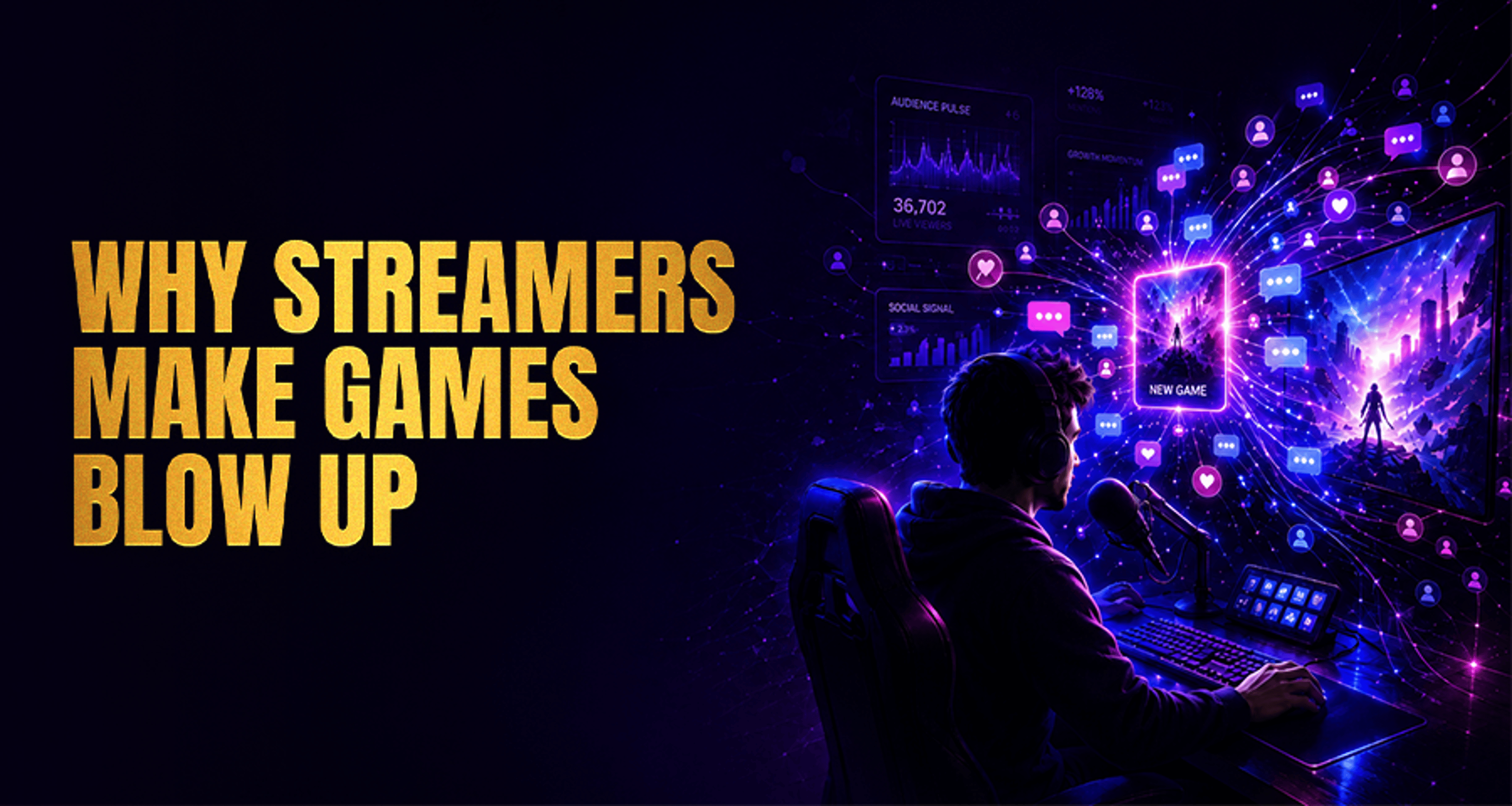
Streamer influence on game popularity is easiest to understand through four connected stages: discovery, trial, retention, and social proof. A creator can put a game in front of a large audience very quickly, but visibility alone does not explain why some games fade after a short burst of attention while others keep growing.
Streams help people see how a game actually plays. They turn trailers and store pages into live demonstrations, real-time reactions, and shareable moments. That can raise awareness, reduce hesitation, and spark discussion across Twitch, YouTube, TikTok, Kick, and other platform ecosystems.
At the same time, correlation is not causation. A game may rise during creator coverage because streams accelerated existing momentum, because a major update landed at the right moment, or because the game already fit what players wanted. Creator exposure can amplify popularity, but it does not guarantee lasting success.
This guide explains how streamers influence game popularity by looking at player behavior: how creators shape discovery, why some games surge after exposure, what separates short-term hype from sustained popularity, and which signals matter most when evaluating real impact.
How streamers shape game discovery
One reason streamer influence matters is that creators affect more than awareness alone. They help people discover games, understand them faster, and decide whether a title feels worth trying.
Discovery
Discovery starts when a streamer introduces a game to viewers who might never have searched for it on their own. Livestreams, clips, reaction videos, and short-form recommendations can place a title in front of people who were not actively browsing store pages or review sites.
A live format is especially effective because viewers can quickly understand pacing, tone, mechanics, and player reactions. Instead of polished marketing, they see the game functioning in real conditions.
Trial
The trial begins when viewers move from interest to action. Streamers can reduce the gap between “that looks interesting” and “I want to try it.” A clear demonstration of the core loop, onboarding, and moment-to-moment play helps people judge whether the experience feels accessible.
This matters most for games with unusual rules, niche formats, or unfamiliar pacing. When a creator makes a system easier to follow in real time, viewers are more likely to test it for themselves.
Retention
Retention is where creator impact becomes more limited. A streamer can drive first sessions, but they cannot create a satisfying experience for the player after that. If onboarding is rough, progression feels thin, or the social experience disappears after the first hour, early attention may not turn into repeat play.
Social proof
Social proof appears when people see others playing, discussing, clipping, and recommending the game. Viewers may interpret broad creator coverage as a signal that a title is relevant, worth trying, or at least worth watching more closely.
That social layer often expands beyond the stream itself through Discord, Reddit, group chats, and reposted clips.
Why some games surge after creator exposure
Not every game gets the same lift from streamers. Some are naturally suited to live viewing, while others are better experiences to play than to watch.
Games often surge after creator exposure when they have:
Readable gameplay that makes sense quickly
Strong novelty that triggers reactions and sharing
Social participation through co-op, competition, or viewer involvement
Low entry friction so interested viewers can try the game easily
Memorable moments that generate clips and discussion
=> Audience fit matters as much as audience size. A mid-sized creator with a tightly aligned community can sometimes drive more meaningful trial than a massive streamer whose viewers enjoy the spectacle but have little interest in playing.
Game category also changes the pattern of influence:
Party and co-op games often benefit from immediate trial because viewers can picture joining friends.
Competitive games may gain visibility fast through skill expression, but retention depends on whether new players can survive the learning curve.
Sandbox and simulation games can grow through creator storytelling and long-form experimentation, often with slower but steadier interest.
Strategy-heavy or rules-dense games may attract curious viewers, but trial depends on how clearly the game can be understood from observation.
=> In other words, streamer influence varies by genre, accessibility, novelty, and audience fit rather than working the same way for every title.
Platform ecosystems change how influence works
Streamer influence is not identical across platforms, because each ecosystem shapes how players discover, discuss, and revisit games.
Twitch tends to reward live momentum, chat energy, and longer watch sessions. A game that creates strong real-time reactions or audience participation may perform especially well there.
YouTube can support both live discovery and long-tail interest through VODs, search behavior, recommendations, and highlight compilations. A game can keep gaining viewers after the live moment passes.
TikTok often accelerates top-of-funnel discovery through short clips. It is powerful for awareness and curiosity, but that spike may be brief unless people can quickly translate interest into play.
Kick and regional ecosystems can matter when specific creator communities are concentrated there. In those cases, platform culture and local audience habits may shape outcomes as much as the game itself.
This is why broad claims about streamer-driven popularity can become too generic. A game may look highly popular on one platform while showing weaker trial or retention elsewhere.
Short-term hype vs lasting player growth
One of the most important distinctions in how streamers influence game popularity is the difference between hype and durable adoption.
Short-term hype usually looks like:
Viewership spikes
Rapid clip sharing
Search lift right after coverage
Sudden social mentions
Brief jumps in downloads or visits
Lasting popularity looks more like:
Repeat play after the first exposure wave
Stable or growing concurrent players
Ongoing community activity
Better retention across days or weeks
Continued creator coverage beyond the initial novelty cycle
Some games are excellent spectator content but weaker long-term products. Others may start quietly and build stronger staying power because the game loop, progression, or social structure supports repeat engagement.
That is why a visibility spike should be treated as a signal, not a conclusion. The stream may open the door, but sustained popularity depends on what players experience after they enter.
Readers interested in how player perception and decision-making can diverge from actual outcomes may also find useful perspective in Should You Switch Games After Losing, which explores how people interpret momentum and streaks.
What makes a game streamer-friendly
Streamer-friendly games usually create value for both the viewer and the player.
Clear visual readability
Viewers need to understand what is happening without much explanation. Fast comprehension improves both watchability and clip performance.
Strong moment density
Funny failures, tense outcomes, dramatic reversals, and unexpected interactions give creators material that spreads beyond the original stream.
Room for creator personality
Some games work well because streamers can add commentary, roleplay, experimentation, or challenge-based play that makes each session feel distinct.
Social hooks
Multiplayer lobbies, co-op systems, or community participation features can turn passive viewing into direct interest.
Accessible first steps
If people become interested, they need a believable path to trying the game. Easy onboarding, familiar systems, and low setup friction all improve the chance that discovery becomes trial.
This same need for clarity is why explainers built around easy-to-follow systems often hold attention better than dense introductions. For example, What Is Casino War works as a simple topic model because the rules are easy to grasp quickly, which is a useful reminder that accessibility shapes audience uptake in many categories.
Metrics that show real popularity impact
To measure streamer influence well, it helps to map indicators back to discovery, trial, retention, and social proof.
Discovery signals
Search lift for the game name or related questions
New social mentions across platforms
Viewership spikes from one or multiple creators
Higher traffic to store pages, websites, or trailers
Trial signals
Increases in downloads or installs
Concurrent player jumps after coverage
Wishlist growth for upcoming titles
More first-time community joins or sign-ups
Retention signals
Stable player counts after the initial spike
Repeat sessions over several days or weeks
Ongoing active community conversation
Return engagement after updates or additional streams
Social proof signals
Multiple creators picking up the game independently
Reposted clips and meme circulation
Community references that persist after launch week
Audience discussion that frames the game as something people should know about
=> No single metric proves popularity on its own. Concurrent players, search lift, wishlist growth, social mentions, and viewership spikes are most useful when interpreted together rather than in isolation.
For example:
High viewership + high search lift + weak retention usually suggests curiosity without staying power.
Wishlist growth + later player conversion can indicate creator coverage successfully moved people from awareness to intent.
Social mentions + multiple creators joining in may show social proof is spreading beyond one channel.
Concurrent player growth that holds after the spike is often a stronger sign of real adoption than raw views alone.
The practical takeaway for publishers and marketers is to watch for pattern alignment. If several signals rise together and some remain elevated after the initial burst, streamer-driven momentum is more likely to reflect meaningful popularity rather than a short-lived spectacle.
Related HunnyPlay coverage such as AI Agent Casino and Smart Casinos also looks at how digital systems influence attention and interaction, which can be useful context when thinking about audience behavior online.
Limits of streamer influence on game success
Streamer influence is powerful, but it has clear boundaries.
First, creator exposure cannot fix a weak player experience. If the game is confusing, repetitive, or frustrating after the first session, attention may not convert into retention.
Second, not all genres benefit equally. Some games are inherently easier to watch than others.
Third, novelty fades. A game built around surprise may trend strongly for a few days and then lose momentum once the format feels familiar.
Fourth, platform ecosystem effects can distort perception. Strong TikTok visibility does not automatically mean strong long-form engagement, and strong Twitch viewership does not always predict broad adoption.
Finally, accessibility, novelty, and audience fit all matter. A game that matches the creator’s community can outperform a technically similar game with weaker alignment.
Correlation vs causation in streamer-driven popularity
It is important not to overstate what streamers alone can do.
If a game rises while creators are covering it, that does not prove the stream caused the entire trend. Other factors may include:
Major patches or feature releases
Seasonal events
Storefront placement
Existing word of mouth
Cross-platform launches
Pre-existing community buildup
Clip circulation outside the original livestream
In many cases, creator coverage accelerates momentum rather than creating it from nothing. The better question is not “Did streamers make this game popular by themselves?” but “How much did creator exposure contribute to discovery, trial, retention, and social proof compared with the other forces already in motion?”
FAQ
How do streamers make games more popular?
Streamers make games more popular by increasing awareness, demonstrating gameplay live, creating social proof, and helping viewers decide whether to try a title themselves.
Can a single streamer cause a game to go viral?
Yes, a single streamer can trigger a large visibility spike, especially if the game creates strong reactions or clip-worthy moments. But viral attention does not automatically become sustained popularity.
Do all game genres benefit equally from streamer exposure?
No. Games with clear visuals, social energy, and spectator-friendly moments often benefit more than slower, denser, or harder-to-read genres.
What metrics show whether streamer coverage helped a game?
Useful metrics include search lift, concurrent player changes, wishlist growth, social mentions, viewership spikes, and retention after the initial attention burst.
Does streamer hype lead to long-term player retention?
Sometimes, but not always. Streamer hype often helps discovery and trial, while long-term retention depends more on game quality, onboarding, updates, and audience fit.
Final thoughts
Streamer influence on game popularity is best understood as a multiplier for discovery, trial, and social proof rather than a guarantee of long-term success. Creators can help a game get noticed, understood, discussed, and tried, but durable popularity is validated only when multiple signals line up over time.
For marketers, publishers, and industry observers, that means looking beyond a single spike. Stronger evidence comes when viewership, search lift, wishlist growth, social discussion, and concurrent players reinforce one another and some of those gains hold after the first wave of attention.
For readers who want more context on gaming trends, player behavior, and digital entertainment topics, HunnyPlay’s Gambling Hub offers related reading across connected subjects.