Why Some Countries Ban Crypto Casinos?
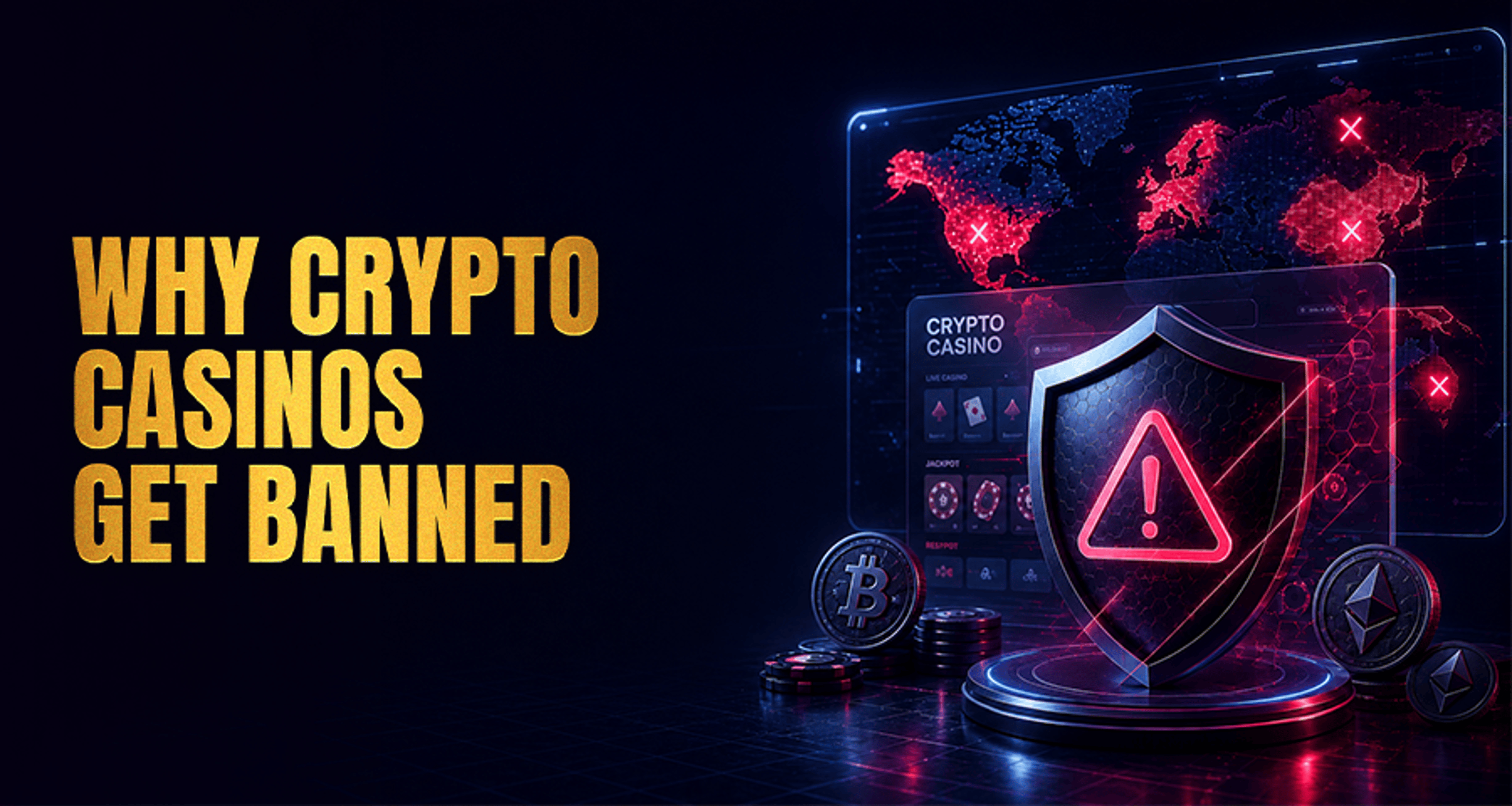
Some countries ban crypto casinos due to gambling laws, AML concerns, tax enforcement, and consumer protection rules. Here's why regulations vary so widely across different markets.
At a glance, crypto casinos can seem global and easy to access. In reality, the reason some countries ban crypto casinos is usually more complex than a simple anti-gambling or anti-crypto stance. These platforms often combine two heavily watched areas at once: online gambling and digital asset payments.
That combination can trigger higher scrutiny around licensing, anti-money-laundering controls, consumer protection, tax reporting, and cross-border money movement. It also explains why the rules are not uniform. One country may ban online gambling broadly, another may allow gambling but restrict crypto payments, and another may leave offshore access in a legal gray area with partial enforcement.
Why governments treat crypto casinos differently from standard online casinos
Governments often see crypto casinos as more difficult to supervise than standard online casinos because they sit at the intersection of:
Online gambling regulation
Crypto payment oversight
Cross-border financial enforcement
Even where online gambling is legal in some form, adding cryptocurrency can raise extra questions about wallet tracing, source-of-funds checks, customer verification, suspicious transaction monitoring, and whether an offshore operator falls outside local licensing rules.
This is the core reason some countries ban crypto casinos more aggressively than conventional online betting sites. Regulators are not only judging the gambling product. They are also judging the payment method, compliance structure, and enforcement risk.
The main reasons some countries ban or restrict crypto casinos
Gambling law and licensing rules
In many jurisdictions, the first issue is gambling law rather than crypto itself.
Some countries prohibit most online gambling outright. Others allow it only through locally licensed operators. If a crypto casino accepts users without the required local authorization, regulators may treat it as illegal even before reviewing how crypto deposits or withdrawals work.
This means a crypto casino can be restricted because it is an unlicensed gambling service, not because cryptocurrency is universally banned in that country.
Anti-money-laundering concerns
AML concerns are one of the biggest reasons some countries ban crypto casinos or place them under tighter control.
Regulators may worry that wallet-based transfers, fast cross-border movement, and uneven compliance standards across operators make monitoring harder than with conventional banking rails. The concern is usually not that crypto is automatically untraceable, but that supervision can become more complicated when gambling activity and digital assets are combined.
Typical regulator questions include:
How customer identity is verified
Whether source of funds is checked
How suspicious activity is monitored
Whether reporting obligations are being met
How much visibility authorities have into offshore payment flows
Consumer protection risks
Consumer protection is another major driver. Authorities may question whether users have practical recourse in disputes, whether terms are transparent, whether responsible gambling tools exist, and whether underage or vulnerable users can be screened effectively.
Crypto can intensify these concerns because transactions may move quickly and may not be easy for ordinary users to reverse in practice.
Tax enforcement and reporting
Some governments restrict crypto casinos because they want stronger oversight of gambling-related tax reporting.
If tax systems depend on licensed operators, local reporting duties, or visible fiat payment rails, offshore crypto gambling may look harder to supervise. In that sense, crypto casinos can be treated as both a gambling-compliance issue and a tax-control issue.
Capital-flow oversight
In countries with strict foreign exchange rules or close monitoring of outbound payments, crypto gambling may attract extra scrutiny. Authorities may worry that digital assets create a channel for moving value outside standard banking controls.
For a broader example of how national crypto policy can evolve over time, see China’s crypto ban history and impact.
Ban vs restriction vs legal gray area: what the differences mean
Not every market handles crypto casinos the same way. The differences matter.
Full ban
A full ban usually means the country prohibits the relevant activity outright, such as online gambling, crypto gambling payments, or both.
Payment restriction
A payment restriction usually means enforcement focuses on blocking money movement rather than banning every related activity in the same way. This can involve banks, cards, payment processors, or crypto-linked transfers.
Licensing block
A licensing block means a country allows online gambling only through approved operators and does not accept certain offshore providers serving local users.
ISP or domain blocking
Some regulators rely on website blocking, app restrictions, DNS measures, or domain enforcement to limit access.
Legal gray area
A gray area exists when the law is incomplete, outdated, inconsistently enforced, or unclear on offshore crypto gambling specifically.
A gray area does not mean permission. It means readers should avoid assuming legality based only on the fact that a website is reachable.
High-level country patterns that explain why some countries ban crypto casinos
While laws differ, a few broad policy patterns appear often:
1. Countries that ban online gambling broadly
In these markets, crypto casinos are usually swept into a wider prohibition on remote gambling. The core issue is the gambling activity itself, and crypto adds another layer of concern rather than changing the outcome.
2. Countries that allow licensed gambling but restrict crypto payments
Some jurisdictions permit online betting under regulated conditions but remain cautious about using crypto for deposits or withdrawals. In that model, gambling may be legal in principle while crypto-linked payment flows remain restricted or heavily scrutinized.
3. Countries that focus on offshore enforcement
Some markets do not ban every form of online gambling in the same way, but they take a hard line against offshore operators serving residents without local approval. That can lead to warnings, payment disruption, domain blocking, or marketing restrictions.
4. Countries with gray-area enforcement
In some places, gambling law and crypto policy do not line up neatly. Traditional online gambling rules may exist, while crypto-specific gambling guidance remains unclear. That can leave users looking at a market where access exists but the compliance position is still uncertain.
How gambling law and crypto policy overlap in enforcement
One of the biggest sources of confusion is that a country can be permissive in one area and restrictive in the other.
For example:
A country may allow some crypto activity but prohibit online gambling
A country may license gambling but restrict crypto as a payment method
A country may tolerate some offshore access while tightening AML enforcement
A country may leave unclear rules in place while still acting against promotion, payments, or unauthorized operators
That overlap is why it is risky to assume that if crypto is legal, a crypto casino must also be allowed.
It is also why regulators pay attention to how these platforms work in practice, including payment speed, wallet movement, and lower-friction user flows. For adjacent behavior context, see The Rise of Quick Sessions in Crypto Casinos. For payment-rail context, see why USDT on Tron is so widely used in crypto casinos.
Common policy concerns: AML, consumer protection, taxes, and capital controls
Across jurisdictions, the same policy concerns appear again and again:
AML monitoring: identity checks, suspicious activity reporting, and visibility into payment flows
Consumer safety: dispute handling, transparency, underage protections, and responsible gambling tools
Tax reporting: oversight of operator obligations and gambling-related taxable activity
Capital controls: concern over cross-border transfers outside standard financial channels
These concerns help explain why the same crypto casino may be accessible in one country, restricted in another, and fully blocked somewhere else.
For another example of how crypto-related policy sensitivity can shape access and visibility, see Why Crypto Content Gets Muted on X.
What readers should check before assuming a crypto casino is allowed locally
Before assuming any crypto casino is allowed in a given jurisdiction, readers should check:
Whether online gambling is legal locally
Whether offshore operators may lawfully serve residents
Whether crypto can be used for gambling payments
Whether local regulators publish warnings, blacklists, or enforcement notices
Whether enforcement targets operators, payments, domains, or promotion
Whether the rules have changed recently
Legal status can change over time, especially where online gambling and digital asset policy overlap. That is why broad articles like this should be treated as educational context rather than legal advice.
FAQ
Why do some countries ban crypto casinos instead of licensing them?
Some countries already prohibit online gambling, while others view crypto gambling as too difficult to supervise under their current AML, consumer-protection, tax, or capital-control systems.
Are crypto casinos banned because of gambling laws or crypto laws?
It can be either one, or both together. In many places, gambling law is the first barrier. In others, crypto payment restrictions create an additional layer of enforcement.
What is the difference between a banned crypto casino and a restricted one?
A banned crypto casino is generally prohibited outright. A restricted one may be affected by licensing limits, payment blocking, domain controls, or partial enforcement without a total prohibition.
Why do regulators worry about crypto payments in online gambling?
They often focus on identity verification, source-of-funds checks, suspicious transaction monitoring, tax reporting, and cross-border payment visibility.
Can a country allow crypto but still block crypto casinos?
Yes. A country may allow some crypto activity while prohibiting online gambling, restricting gambling-related payments, or requiring local licenses that offshore crypto casinos do not hold.
Do crypto casino rules change often by country?
They can. Gambling regulation, crypto policy, and enforcement standards can all change, so readers should check current local rules before relying on older summaries.
Conclusion
The reason some countries ban crypto casinos is not usually a single policy concern. It is the combined effect of gambling regulation, crypto oversight, AML enforcement, consumer protection, tax control, and cross-border payment risk.
That is why outcomes vary so widely from one market to another. Some countries impose broad bans, some restrict payments or licensing, and some leave users in uncertain gray areas.
For more educational context, readers can explore HunnyPlay’s broader crypto casino guides while keeping the focus on understanding platform mechanics, policy differences, and the importance of checking current local rules before making assumptions.